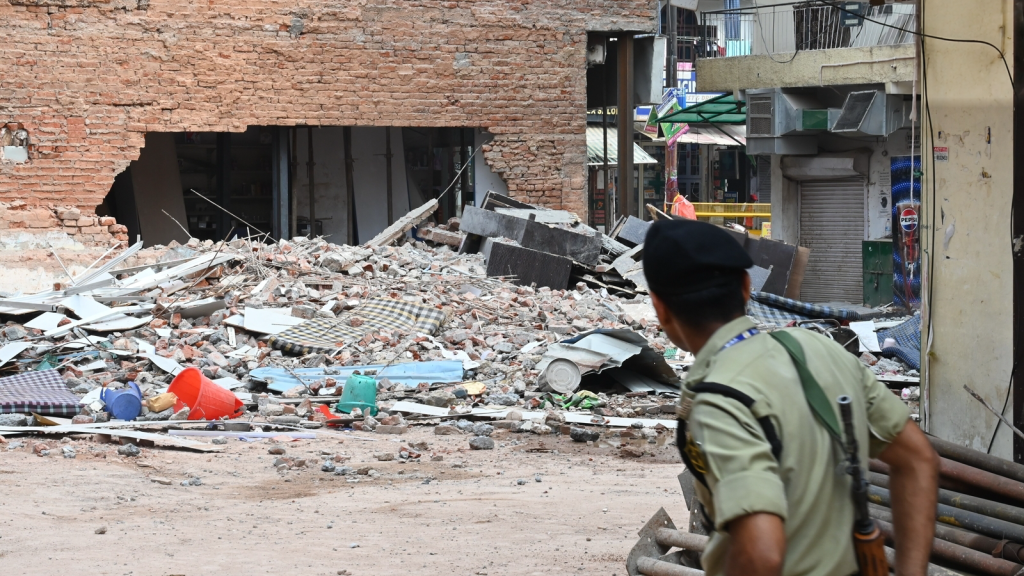
The Municipal Corporation of Delhi (MCD) has informed the Union Home Ministry that conducting a comprehensive, door-to-door structural and fire safety assessment of all buildings in the national capital would require approximately four million man-hours. This projection follows a directive issued by the central government last month, which tasked the civic body with developing a roadmap for a citywide audit covering every house and building, spanning both authorized and unauthorized localities.
The mandate from the Union Home Ministry was prompted by a string of recent building collapses and fire incidents across Delhi. In response, senior municipal officials submitted a report outlining the extensive resources and timeline necessitated by such an undertaking. Officials estimated that Delhi contains over 40 lakh (four million) building structures. Based on the assumption that a single assessment would require one man-hour per structure, the survey would demand 40 lakh working hours, equivalent to 500,000 working days. Providing a breakdown of the logistical scale, officials noted that if a team of 500 workers were deployed, the audit would take approximately 1,000 days to complete, with the duration scaling based on the total number of personnel assigned.
Civic authorities have emphasized that the final decision regarding the execution of this audit and the associated timeline rests with the central government. The proposed survey is designed as a data-collection exercise, requiring surveyors to document building age, covered area, visible structural deficiencies, and the presence or absence of a fire No Objection Certificate (NOC) or approved building plan. This data is intended to serve as a foundation for future policy development to address the broader issue of building safety in the city.
Municipal officials have raised significant concerns regarding the capacity of current civic infrastructure to support this initiative. Currently, the MCD lacks a dedicated unit specializing in structural safety audits and does not employ permanent structural engineers. Instead, the corporation relies on a panel of 249 third-party structural engineers. Should the full survey of four million buildings proceed, each engineer would be responsible for assessing more than 16,000 structures—a number that would rise even higher if the audit were expanded to cover all 7.6 million census houses. While the MCD currently performs an annual survey of approximately 3.25 million buildings, this effort relies on basic visual inspections to identify obvious warning signs like leaning walls or cracks, rather than the detailed structural and fire safety evaluation requested by the ministry.
The fiscal and technical hurdles remain substantial. A formal scientific structural audit would be considerably more expensive, with costs ranging from ₹1 lakh to ₹5 lakh per building depending on the area. The Union Home Ministry is currently deliberating whether to mandate the hiring of external third-party agencies or to utilize the services of architects already empanelled with civic bodies.
The challenge of implementing such safety standards is not new. In June 2020, following intervention by the Delhi High Court, the erstwhile municipal corporations established a six-month deadline for older structures and high-risk buildings to obtain structural safety certificates. Even six years later, that exercise has covered only a few thousand buildings. Furthermore, historical data from the 2006 Tejendra Khanna Committee report suggested that 70% to 80% of structures in Delhi have violated building norms. Given that Delhi is situated in Seismic Zone IV, indicating high earthquake risk, officials suggested that any future audit must prioritize high-rise structures, large assembly venues, government offices, and other high-vulnerability properties.