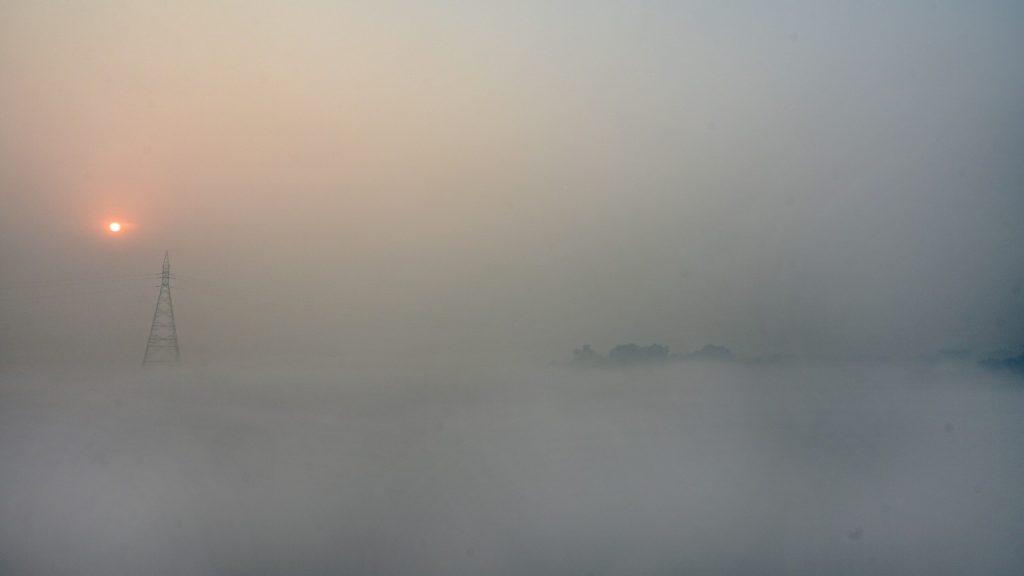
Delhi spent most of this week breathing inside a shrinking room. On Tuesday afternoon, the city’s smoke, dust and vehicle exhaust had 1,411 metres of air above the ground in which to spread. By Thursday, that ceiling had fallen to 396 metres — lower than a normal early-January afternoon — and PM2.5 across the city more than doubled in a day. The ceiling cannot be seen from the ground. A weather balloon launched from the India Meteorological Department’s Safdarjung observatory can find it.
A balloon launch twice a day
The balloon goes up at about 4.30am and 4.30pm every day. As it climbs, it radios back what the air is doing at every height: how warm it is, how far the day’s pollution has been stirred upwards, and how hard and from which direction the wind is blowing. A small instrument pack beneath it reports pressure, temperature, humidity, wind speed and wind direction from the rooftops to several kilometres up.
The two flights bracket the day. The 4.30am balloon rises at the end of a long night of cooling, when the air near the ground is at its coldest and stillest. The 4.30pm balloon rises after the afternoon’s strongest stirring, so it can come in a little below the highest point the air reached earlier in the day. Only flights that clear 3,000 metres are used in the six-winter comparison here; readings reach the public archive about two hours after launch.
The dome: how high the air mixes
On a sunny afternoon, the sun does most of the work of clearing Delhi’s air. As the ground warms through the day, the air touching it warms too and rises in bubbles, hauling pollution upwards and pulling cleaner air down. The height those bubbles reach is the mixing height. Everything the city emits gets diluted in the layer beneath it, which is why it helps to think of that layer as a dome over Delhi: the taller the dome, the more air there is to thin the pollution out.
Finding the top takes a little physics. Rising air expands and cools by about 10°C for every kilometre. To find it, each of the balloon’s readings is corrected for that cooling, and the first height where the surrounding air is 1°C warmer than a bubble rising from the ground would be is identified. Above that line, the surrounding air is too warm and too light for the bubbles to push into, and the stirring stops.
A seasonal lid that sinks into winter
The dome rises and sinks with the seasons. Over the six winters from 2019-20 to 2024-25, the 4.30pm balloon usually found it about 1,800 metres tall in early October, 1,300 metres in November and 1,200 metres in early December. It then sank to about 600 metres in the first half of January, its lowest fortnight, as the days shortened and the sun weakened.
After sunset, the order flips. The ground sheds its heat quickly and chills the air touching it, while the air a few hundred metres up holds on to its warmth. That warm layer acts as a lid: the cold air underneath, loaded with the evening’s smoke and dust, is too heavy to rise through it.
Delhi gets this lid almost every winter night. Across the six winters, the 4.30am balloon found one on 94% of mornings from October to January and on 97% of November mornings. On Thursday, it found the air 207 metres up 6.2°C warmer than at the ground — 24.2°C against 18°C.
By mid-morning, the sun usually breaks the lid open. On Thursday it did, but only just. The 4.30pm balloon found no lid, yet above about 170 metres the air cooled with height far more slowly than a rising bubble does. The bubbles quickly ran out of lift, and the dome topped out at 396 metres.
The wind inside the dome
A tall dome is only half the cure. Still air in a deep dome leaves pollution to stew, while a strong wind through a shallow one can still sweep pollution away. Multiplying the dome’s depth by the average wind blowing through it gives the ventilation index, a single number for how much air the city has to dilute its own emissions.
IMD counts a ventilation index below 6,000 square metres a second as unfavourable for clearing pollution. Delhi’s was 5,873 on Tuesday afternoon, 2,290 on Wednesday and 934 on Thursday — a collapse of 84% in two days to less than half the usual figure for early January.
Calm at street level, stronger wind above
Down at street level, Delhi’s winter air hardly moves. In October and November 2024, 66% of the reports from IMD’s Safdarjung observatory recorded calm air, against 26% at Indira Gandhi International airport, 15 km away on open ground. At night, Safdarjung was calm in 79% to 98% of its reports. It has not yet been worked out how much of that gap comes from the city crowding the station and how much from where the instrument stands.
A kilometre or two up, the wind is far stronger, and it mostly comes from one direction. Over the six winters, the 4.30am balloon found the wind between 1 km and 2 km blowing from the west, north-west or north on 82% of October mornings and 74% of November mornings, typically at about 21 km/h. From the east, it blew on just 2% to 5% of mornings.
That northwesterly has to cross Punjab and Haryana to reach Delhi, and in October and November its route runs straight over the farm-fire belt. On Thursday morning, the balloon clocked it at 34 km/h, from the north-west at every level up to 3 km, two days after it had slumped to 5 km/h. Smoke riding in above the dome can be dragged down to street level once the afternoon stirring reaches it, though the balloon alone cannot say how much of it does.
A turn of wind can matter as much as rain
In daily readings this season, a turn of the wind has done as much as rain to clear the air, and sometimes more. On October 11 and 12, most of the fall in Delhi’s PM2.5 came with a change of wind on the Sunday evening, hours before 42 mm of rain fell early on Monday. Rain does scrub particles out of the air, but it is credited only when it is more than a passing shower: 2.5 mm or more at Safdarjung, the amount IMD counts as a rainy day.
What the evening balloon says next
Two numbers from the 4.30pm balloon tell most of the story each evening: the mixing height and the ventilation index, set against the usual for the fortnight. A dome under about 1,000 metres with less than 10 km/h of wind through it leaves the day’s pollution little room to thin out, and the night’s lid then holds whatever is left over the city until morning.
The worst of the season is still ahead. On the six-winter record, the usual dome shrinks by half between early December and early January, from about 1,200 metres to about 600, and the usual ventilation index falls from about 4,700 to 2,200. On Thursday, Delhi got a January afternoon in the middle of November.