Sarvam AI has launched Token Factory, a unified inference platform that gives businesses and developers access to its own models and several open-weight models developed elsewhere, including Chinese systems, while running them on GPU clusters in India. The launch has renewed a debate about what AI sovereignty means for India because Sarvam is one of the companies selected under the government’s IndiaAI Mission to build homegrown artificial intelligence models.
Token Factory is a commercial service. It allows customers to use different AI models through one API without setting up or managing their own computing infrastructure. The platform covers Sarvam’s models as well as DeepSeek, GLM, Kimi and Google’s Gemma. Sarvam says users can reach the models through a single application programming interface, which connects their applications to the AI service and sends requests. The platform then runs the model and generates responses, a process known as inference.
What the platform offers
Sarvam describes Token Factory as an inference stack serving its own and other open-weight models from GPU clusters in India. Its catalogue lists Sarvam 105B, DeepSeek V4.1 Flash and V4 Pro, Kimi K3.1 Pro, GLM 5.3 and Flash, and Gemma 4 31B. Developers access the models through an OpenAI-compatible API. They configure the endpoint, choose a model and send requests.
Pricing is based on tokens, the small units of text that a model reads or generates. Sarvam charges separately for input tokens, cached input tokens and output tokens. Rates vary by model and are listed in rupees per million tokens. The company says the service handles more than 450 billion tokens a day through DeepSeek V4.1 Flash.
The commercial pitch is straightforward: a business can select a model that fits its needs and pay for usage without buying GPUs or building a serving stack. Sarvam says its system is designed to make inference faster and more cost-effective by managing how requests are sent to its GPUs and by reusing parts of earlier prompts where possible.
How Token Factory processes a request
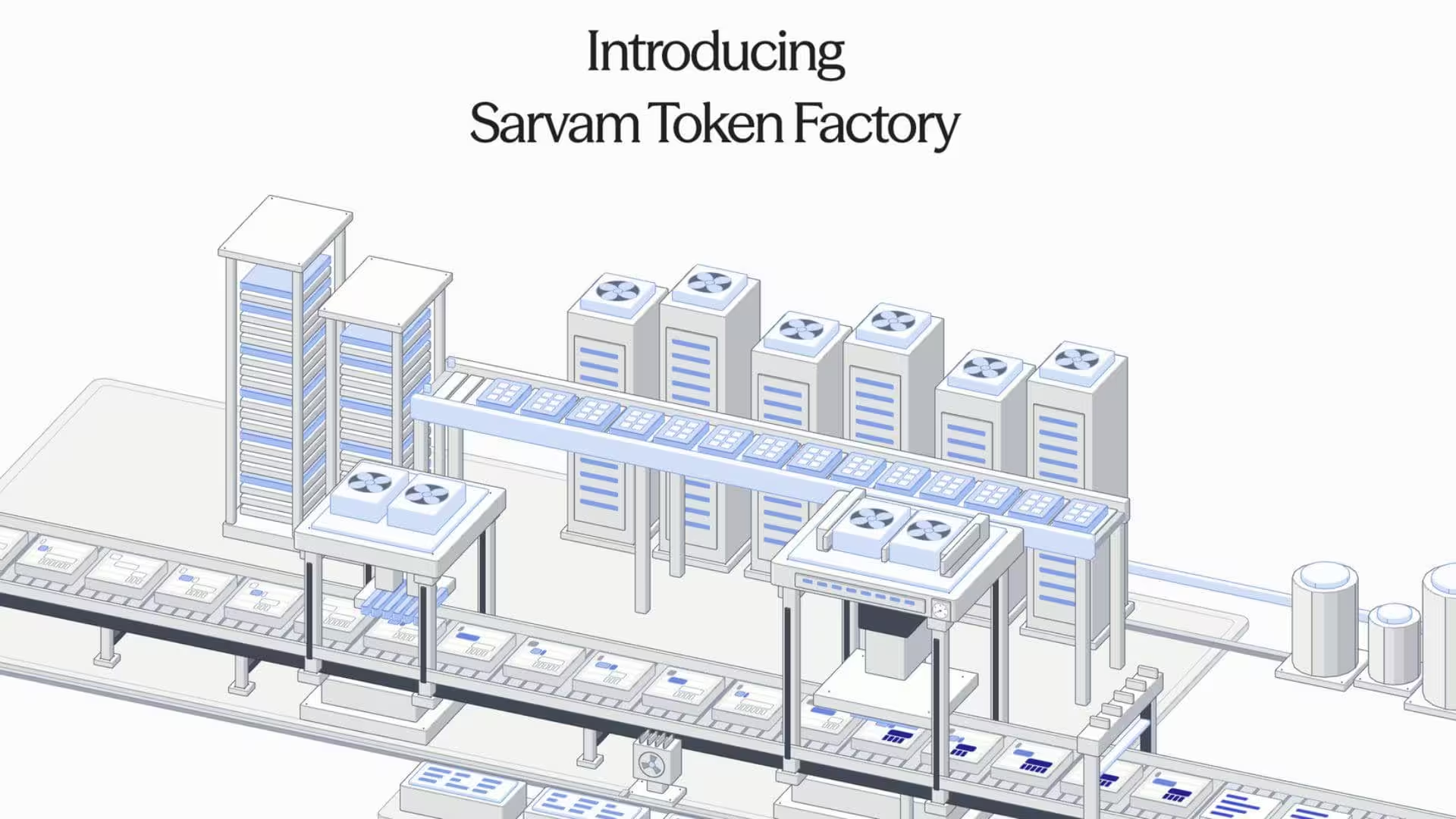
Sarvam says the work between a request and a response is managed through three layers: an inference engine, a cache and a control plane. The engine runs the model on graphics processing units. The cache stores reusable prompt information so the system does not process the same context repeatedly. The control plane manages requests, routes them to the appropriate resources and adjusts capacity according to demand.
The engine separates processing into prefill and decode. Prefill reads the full prompt, including earlier conversation or context. Decode generates the answer one token at a time. Sarvam says these tasks run on separate GPU pools because they have different computing requirements. That separation can stop long prompts from slowing response generation for other users.
Caching matters in long conversations and AI agent workflows, where a model may receive the same context repeatedly. Without a cache, the system processes those tokens again, adding cost and delay. Sarvam says its multi-tier cache uses GPU memory and shared storage to reuse prompt information. A cache-aware router can direct returning requests to servers where the relevant context is already available.
Why the service triggered a sovereignty debate
The central criticism is not that Token Factory runs multiple models. It is that a model’s country of origin differs from the country where it is hosted. DeepSeek, Kimi and GLM were developed by Chinese companies. Running their open-weight versions on Indian GPUs does not make them Indian, transfer their intellectual property to Sarvam or give India control over their development. The question is whether India is building its own AI capabilities or mainly providing infrastructure to run models developed elsewhere.
AI sovereignty is broader than data localisation or the nationality of a model developer. The term covers the ability to set rules for how AI systems are developed and used, audit their behaviour, protect sensitive information and maintain access to critical computing resources. A locally hosted model may satisfy some data-handling goals while leaving control over model design, training and future direction in the hands of a foreign developer.
Sarvam’s role in India’s AI ecosystem has intensified the scrutiny. The company was selected under the IndiaAI Mission, which seeks to strengthen domestic AI capabilities, including indigenous foundation models, and it received subsidised computing resources to train its own models. That has raised questions about whether government support for developing homegrown AI was also benefiting a commercial platform offering access to Chinese AI models.
Sarvam’s response on subsidies and mission
Sarvam says Token Factory does not use government-subsidised GPUs. Co-founder Pratyush Kumar said the platform runs on privately procured GPUs. The company says its subsidised access under the IndiaAI Mission, used to train its own models, ended in March 2026. It maintains that developing its own models remains its core mission, while offering other models generates revenue.
Sarvam argues that model development is expensive and that inference can generate revenue from computing infrastructure. It says Indian businesses should be able to use global models through a domestic provider, with local infrastructure and rupee pricing. Global cloud providers such as Amazon Web Services also offer businesses access to AI models developed by other companies through platforms such as Amazon Bedrock.
Data sovereignty and the limits of local hosting
Data sovereignty is another concern. Sarvam says Token Factory runs AI models on its GPU infrastructure in India and does not send customer prompts to the overseas providers that developed those models. The company also says it offers zero data retention on request, under which prompts and responses are not stored.
Keeping data in India does not automatically address every security concern. Businesses also need to examine how data is accessed, how long it is retained and what security measures are in place. Hosting a foreign-developed model in India also does not make the model indigenous.
Other Indian platforms and the commercial case
Sarvam is not the only Indian company offering access to foreign-developed models through infrastructure in India. E2E Networks and IndieRouter also provide such services. E2E Networks launched its Blaze inference platform on November 2, 2026, offering models such as DeepSeek, Qwen, GLM and Gemma through a single API.
Sarvam’s position is different because it was selected under the IndiaAI Mission to develop indigenous foundation models and has been seen as an important part of India’s effort to build its own AI technology. The criticism has therefore centred on whether a company backed by the government to develop homegrown AI should also build a commercial business around models developed in other countries, particularly China. The reaction has been shaped partly by the expectations attached to Sarvam as a symbol of India’s AI ambitions.
Supporters argue that hosting foreign models can be a business opportunity and allow Indian companies to serve customers using locally available computing infrastructure. Chinese AI companies have developed several powerful open-weight models, including DeepSeek, Kimi and GLM. Unlike some AI services that can only be accessed through a company’s own platform, open-weight models can be downloaded and run on a company’s own servers. That makes them an option for businesses that want to use advanced AI models without relying on services such as OpenAI or Anthropic.
For Sarvam, offering these models gives it another source of business besides developing its own AI models. It can attract companies that want to use models such as DeepSeek or Kimi but do not have the GPUs or technical resources to run them themselves. Sarvam provides the computing infrastructure and access through Token Factory. The debate over whether that model serves India’s sovereignty goals, or merely deepens its role as a host for foreign technology, remains unresolved.