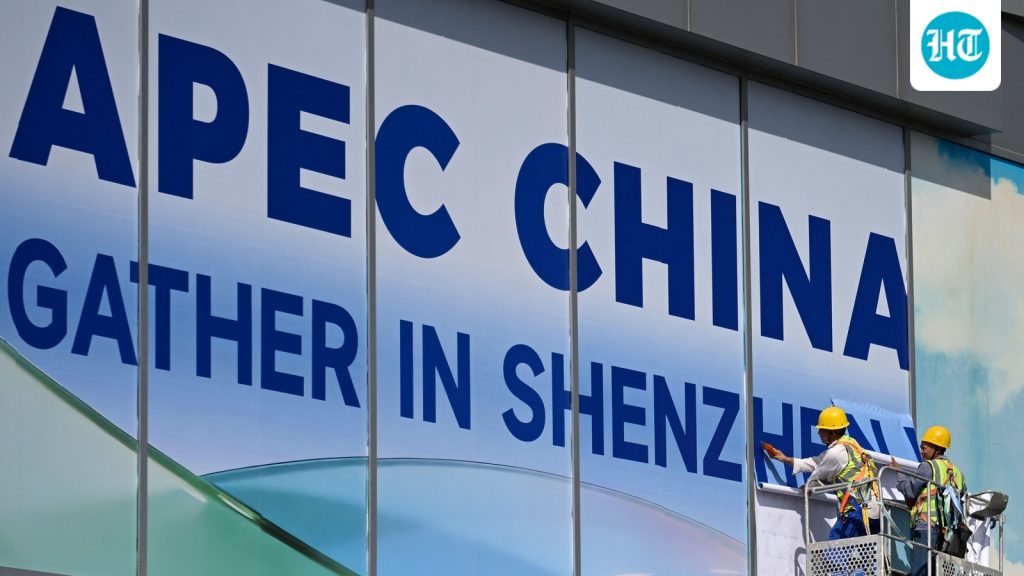
US President Donald Trump, Russian President Vladimir Putin and Chinese President Xi Jinping are set to be in the same venue next week in Shenzhen for the Asia-Pacific Economic Cooperation (APEC) leaders’ meeting, with tariffs, the Ukraine war, Middle East instability and Taiwan pressing on a 21-economy forum that runs on voluntary pledges.
Xi will chair the leaders’ meeting on November 18 and 19 and deliver remarks, China has said. An annual summit of chief executives precedes it on November 17 and 18.
What APEC is — and the India gap
Founded in 1989 in Canberra as an informal 12-member dialogue, APEC has grown into the region’s premier economic forum for advancing growth, trade and investment. Its members account for about 62% of global GDP and roughly half of global trade.
The grouping calls its participants “member economies” rather than nations, an arrangement that allows Chinese-ruled Hong Kong and democratically governed Taiwan — which Beijing claims as its own territory — to take part. India, the world’s most populous country, is not a member, so Indian officials will not be at the table when the 21 economies take up tariffs, supply chains and energy security.
APEC works through non-binding commitments reached strictly by consensus, with obligations undertaken on a voluntary basis. That keeps the membership broad but limits what the forum can enforce.
Why Shenzhen
China is hosting the summit for the third time, after Shanghai in 2001 and Beijing in 2014. Chim Lee, senior analyst at the Economist Intelligence Unit, said both domestic and international reasons govern the choice of Shenzhen, which sits next to Hong Kong.
Within the Greater Bay Area that also includes Hong Kong and Macau — which Beijing wants to build into a global hub for technology and innovation — the city offers a platform to showcase China’s vision for development and trade, Lee said. It also underlines Shenzhen’s resilience to geopolitical turbulence. The city is the base of Chinese auto and technology majors including BYD, Huawei and Tencent.
Who is expected
Xi, as host, will chair the leaders’ meeting. Trump, Putin and Philippine President Ferdinand Marcos Jr. are among those expected, along with the leaders of Canada, Australia, Mexico and Indonesia, and of Malaysia, South Korea and Vietnam among Asia-Pacific nations.
Taiwan has designated Stan Shih, founder of Acer, as its envoy, and its president has said the island is taking part on an “equal basis”. Tokyo has not formally said whether Prime Minister Sanae Takaichi will attend, and New Zealand has not officially confirmed its delegation.
The sticking points
Middle East instability
The economic ripple effects of conflict — risks to energy security, trade flows and supply chains, plus inflation — are major concerns expected to figure in the talks.
China, Russia and the US
Attention is focused on a possible meeting of the Chinese, Russian and US leaders. Analysts say China is hesitant to engage in talks on nuclear disarmament because it holds fewer such weapons than the other two. Washington and Moscow will also be keen to discuss the Ukraine war, though not necessarily with China.
China-US relations
A key question is whether ties can stay stable. Both sides are falling short of commitments to an extended trade truce, analysts said. Rare earth supplies, artificial intelligence and tariffs are likely to be on the agenda, with US arms sales to Taiwan closely watched.
China’s ties with Japan and the Philippines
Strains with Japan have persisted since Prime Minister Takaichi angered Beijing in November 2025 by suggesting Japan could deploy its military if a Chinese move against neighbouring Taiwan also threatened its territory. China-Philippines relations will likewise be watched amid continuing tension in the disputed waterway of the South China Sea.
The 21 members
Australia, Brunei, Canada, Chile, China, Hong Kong, Indonesia, Japan, South Korea, Malaysia, Mexico, New Zealand, Papua New Guinea, Peru, the Philippines, Russia, Singapore, Taiwan, Thailand, the United States and Vietnam.