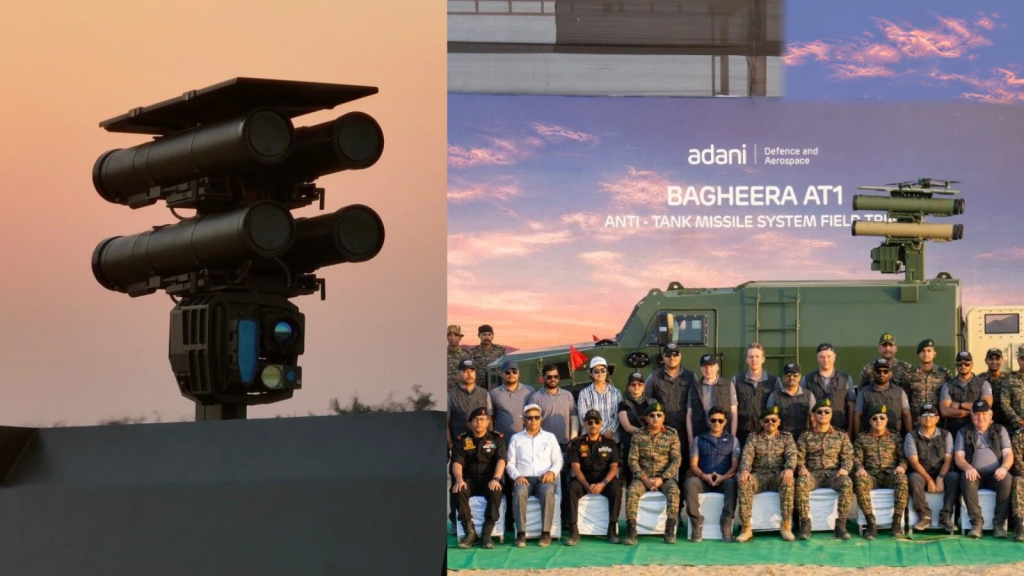
Adani Defence & Aerospace has demonstrated its Bagheera AT1 vehicle-mounted anti-tank guided missile system at the Pokhran Field Firing Ranges in Rajasthan, testing a weapon designed to strike armoured targets at distances of up to 8 km. The November 20 exercise was witnessed by senior representatives of the Indian Army, the Department of Military Affairs and the Ministry of Defence. Adani Defence described the event as a No Cost No Commitment (NCNC) demonstration, which allows the armed forces to evaluate the system without any purchase commitment.
Adani Defence said the programme validated day and night engagements, a two-missile tandem firing along a single beam against a target representing an armoured vehicle, and an engagement of an aerial target at extended range. A static display of the complete system followed the firing exercise. The demonstration does not mean that the Indian Army has inducted or ordered Bagheera AT1; the NCNC trial gives the armed forces an opportunity to assess the complete combat platform.
What is Bagheera AT1?
Bagheera AT1 is a vehicle-mounted anti-tank guided missile system developed and integrated by Adani Defence & Aerospace. It combines a guided missile, an automated launcher, day-and-night targeting sights and a high-mobility armoured vehicle. Adani Defence said the system was developed over 18 months, with modifications made for India’s terrain, climatic conditions and operational requirements. The result, the company said, is a complete combat system built around an Adani Defence-designed 4×4 high-mobility armoured vehicle. Unlike man-portable anti-tank missile systems, Bagheera AT1 is meant to provide mobile, vehicle-based firepower, allowing troops to launch missiles from a protected position and relocate quickly.
Capabilities and specifications
Range of up to 8 km
Bagheera AT1 can engage armoured targets at distances of up to 8 km. Adani Defence says this is roughly twice the 4-km range of the land-based anti-tank missile it cites. The longer reach is intended to let operators target armoured vehicles while keeping a greater distance from enemy positions.
Laser beam-riding guidance
The missile uses laser beam-riding guidance rather than a radio communication link. Adani Defence says this makes the system highly resistant to electronic jamming, a capability that is increasingly important as electronic warfare and drones become more common in modern conflicts.
Two-missile tandem firing
Bagheera AT1 can fire two missiles in quick succession along the same laser beam towards a single target. The company says the first missile is meant to engage a tank’s Active Protection System, while the second is designed to penetrate the vehicle’s defences. An Active Protection System detects and intercepts incoming threats before they hit an armoured vehicle, and the tandem-firing approach is intended to overcome such defences.
12 missiles per vehicle
The automated launcher carries four ready-to-fire missiles, while the vehicle carries eight additional reloads. That gives each vehicle a total capacity of 12 missiles, allowing it to sustain engagements without immediately needing extra ammunition support.
Day and night targeting
The system includes day television and thermal-imaging sights, along with automated target tracking. These features allow military personnel to identify and engage targets in different visibility conditions, including at night.
Shoot-and-move capability
The vehicle-mounted design allows the crew to launch missiles from a protected position and move quickly afterwards. This shoot-and-move capability is intended to reduce the crew’s exposure to enemy fire after an engagement. The Pokhran exercise also tested the system’s ability to engage aerial targets at extended ranges.
What is an anti-tank guided missile?
An anti-tank guided missile (ATGM) is a guided weapon designed primarily to destroy or disable armoured vehicles, especially tanks. Unlike conventional unguided rockets, ATGMs can be directed towards their targets using technologies such as laser beams, wire guidance and radio-frequency systems. They are used by ground forces and can be launched from vehicles, helicopters and man-portable launchers. Bagheera AT1 belongs to the vehicle-mounted category, which combines mobility with a longer engagement range.
Why India is looking at more anti-tank missiles
The demonstration comes as India continues to modernise its anti-tank missile inventory. Adani Defence said the in-service backbone remains the second-generation Milan-2T and Konkurs-M, with Spike missiles subsequently inducted to address immediate operational requirements. India is also progressing with the acquisition of Javelin systems. The company said recent conflicts have underlined the importance of range and mobility in armoured engagements. It positioned Bagheera AT1 as an additional long-range, mobile ground capability alongside man-portable and helicopter-launched missiles.
What it means for defence manufacturing
The exercise also highlights the expanding role of private companies in India’s defence manufacturing ecosystem. Figures cited by Adani Defence put India’s defence production at a record ₹1.78 lakh crore in FY26, while defence exports reached ₹38,424 crore. The private sector accounted for approximately 24% of total defence production, up from 22% in the previous financial year. Adani Defence said it undertook the design, development, integration and testing of the complete Bagheera AT1 combat system, giving the armed forces a platform for evaluation. The company said the programme would help build domestic capabilities in manufacturing, integration and support of advanced anti-armour systems, potentially reducing dependence on emergency imports.