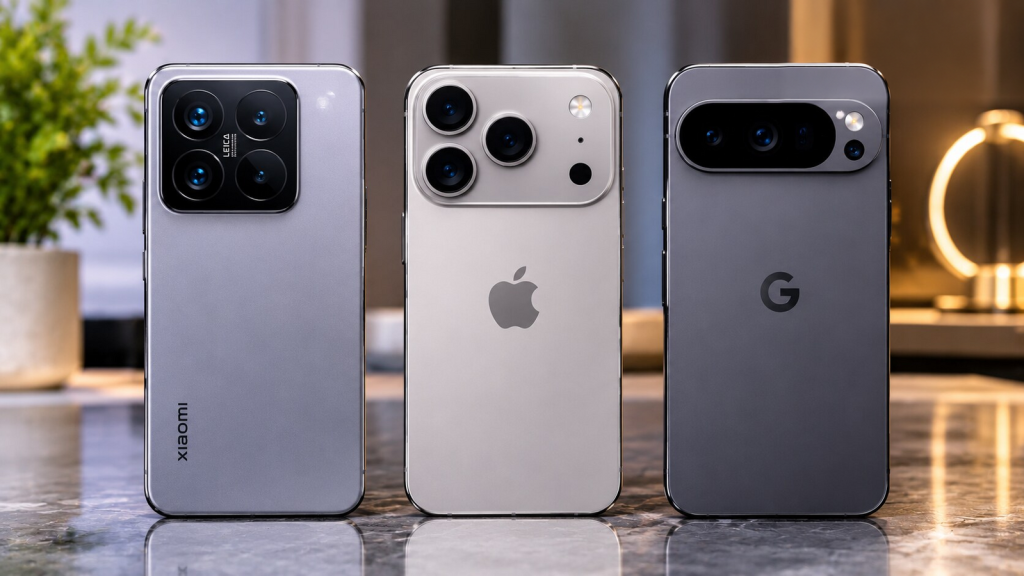
Xiaomi’s 18 Pro, Apple’s iPhone 18 Pro and Google’s Pixel 11 Pro are three premium smartphones competing for high-end buyers in India, but they differ sharply on price, camera hardware, battery design and software support. Xiaomi released the 18 Pro globally on 17 November with two 200MP rear cameras, a 2.7-inch rear display and a 6,000mAh battery. Apple’s iPhone 18 Pro centres on the 2nm A20 Pro chip and an all-48MP rear camera array, while Google’s Pixel 11 Pro pairs the Tensor G6 chip with a 50MP-led triple camera and a seven-year update commitment. The Pixel 11 Pro has confirmed India pricing starting at ₹119,999. Xiaomi has announced European pricing but has not confirmed an Indian launch or India price, leaving its local competitive position uncertain.
The comparison below covers manufacturer-published specifications and pricing available on 23 November. It examines what buyers in India get at each price point, where the three devices diverge and which details remain unconfirmed.
Price in India and availability
Xiaomi’s 18 Pro starts at EUR 1,399, or roughly ₹144,000, for the 12GB RAM and 256GB storage model. The 512GB version is priced at EUR 1,599, about ₹162,000. Those are European prices and rupee conversions are indicative; Xiaomi has not announced Indian pricing or availability. The company’s India launch plans remain unconfirmed.
Apple’s iPhone 18 Pro starts at ₹164,900 for the 256GB model. The 512GB, 1TB and 2TB versions cost ₹189,900, ₹239,900 and ₹314,900 respectively.
Google’s Pixel 11 Pro starts at ₹119,999 for 12GB RAM and 256GB storage. Its 512GB variant is priced at ₹134,999.
Among the three announced starting prices, the Pixel 11 Pro’s ₹119,999 is the lowest. Xiaomi’s European price converts to roughly ₹144,000, while the iPhone 18 Pro starts at ₹164,900. Xiaomi’s eventual India price, if confirmed, could change the comparison.
Display and design features
Xiaomi’s 18 Pro has a 6.4-inch AMOLED display with a resolution of 1,120 x 2,436 pixels and an adaptive refresh rate of up to 120Hz. It adds a 2.7-inch rear display for notifications and other functions, plus a privacy display mode intended to limit visibility from side angles.
The iPhone 18 Pro uses a 6.3-inch Super Retina XDR OLED display with ProMotion technology and a 120Hz refresh rate. It also supports an always-on display.
Google’s Pixel 11 Pro has a 6.3-inch Super Actua LTPO OLED screen with a 1,280 x 2,856 pixel resolution. Its adaptive refresh rate runs from 1Hz to 120Hz, with 2,400 nits of HDR brightness and 3,600 nits of peak brightness. Corning Gorilla Glass Victus 2 provides protection.
Processor, memory and software
The Xiaomi 18 Pro runs Qualcomm’s Snapdragon 8 Elite Gen 6 chipset, built on a 2nm process. It ships with HyperOS 4, based on Android 17, and supports up to 12GB of LPDDR5X RAM and up to 512GB of UFS 4.1 storage.
Apple’s iPhone 18 Pro is powered by the 2nm A20 Pro chipset and runs iOS 27. It is available with up to 2TB of storage. Apple has not disclosed the RAM capacity.
Google’s Pixel 11 Pro uses the Tensor G6 processor and a Titan M3 security coprocessor. It runs Android 17 and offers up to 16GB of RAM and 512GB of storage. Google guarantees seven years of support for the operating system, security updates and Pixel Drop updates. The Pixel 11 series also introduces upgraded on-device AI capabilities, which Google announced on 12 August.
Cameras and imaging
Xiaomi gives the 18 Pro a Leica-branded 200MP primary sensor, a second 200MP rear camera and a 50MP ultra-wide camera. The rear setup includes optical image stabilisation. A 50MP front camera handles selfies and video calls.
The iPhone 18 Pro has three 48MP rear cameras: a variable-aperture Fusion primary camera, an ultra-wide camera and a telephoto camera. An 18MP Centre Stage front camera is included.
The Pixel 11 Pro combines a 50MP primary camera with a 48MP ultra-wide camera that supports autofocus and a 48MP telephoto camera with 5x optical zoom. Its front camera has a 42MP sensor.
Xiaomi offers the highest megapixel counts on its primary and telephoto cameras. Sensor resolution alone does not determine overall image quality, so the difference does not automatically make the Xiaomi phone the better camera device.
Battery, charging and other features
The global version of the Xiaomi 18 Pro has a 6,000mAh battery with 100W wired charging and 50W wireless charging. It also supports 27W wired reverse charging. The Chinese version has a larger 7,000mAh battery.
Apple does not reveal the iPhone 18 Pro’s battery capacity. It claims up to 36 hours of video playback. With a compatible wired charger, the phone can reach up to 50% charge in about 15 minutes.
Google has equipped the Pixel 11 Pro with a 4,850mAh battery and promises more than 30 hours of battery life. It supports 30W wired charging and 25W Qi2.2 wireless charging.
Other differences include Xiaomi’s 2.7-inch rear display and privacy display mode, Apple’s always-on screen and Centre Stage front camera, and Google’s Titan M3 security chip, Gorilla Glass Victus 2 protection and seven-year software support.
| Specification | Xiaomi 18 Pro | iPhone 18 Pro | Pixel 11 Pro |
|---|---|---|---|
| Starting price | EUR 1,399 (approx. ₹144,000); India price not announced | ₹164,900 for 256GB | ₹119,999 for 12GB/256GB |
| Main display | 6.4-inch AMOLED | 6.3-inch OLED | 6.3-inch LTPO OLED |
| Refresh rate | Up to 120Hz | 120Hz | 1–120Hz |
| Rear cameras | 200MP + 200MP + 50MP | 48MP + 48MP + 48MP | 50MP + 48MP + 48MP |
| Front camera | 50MP | 18MP | 42MP |
| Battery | 6,000mAh | Not disclosed | 4,850mAh |
| Wired charging | 100W | 50% in about 15 minutes | 30W |
| Wireless charging | 50W | MagSafe | 25W Qi2.2 |
| Operating system | HyperOS 4 on Android 17 | iOS 27 | Android 17 |
| Maximum storage | 512GB | 2TB | 512GB |
| Rear display | 2.7-inch | No | No |
How the three compare for buyers
The Xiaomi 18 Pro leans on its 6,000mAh battery, 100W wired charging, dual 200MP rear cameras and a secondary rear display. Buyers who want the widest storage option or Apple’s iOS ecosystem will find the iPhone 18 Pro’s 2TB ceiling, variable-aperture camera and A20 Pro chipset more relevant. The Pixel 11 Pro’s strongest case rests on its lower India starting price, 16GB RAM option, seven-year software-support promise and Google’s Tensor G6 platform.
Price and local availability remain the decisive variables in India. The Pixel 11 Pro has a confirmed ₹119,999 starting price, while the iPhone 18 Pro begins at ₹164,900. Xiaomi’s European pricing suggests a premium positioning, but the company has not confirmed whether the 18 Pro will launch in India or at what price. Its India strategy will therefore be an important factor in how it competes with Apple and Google.