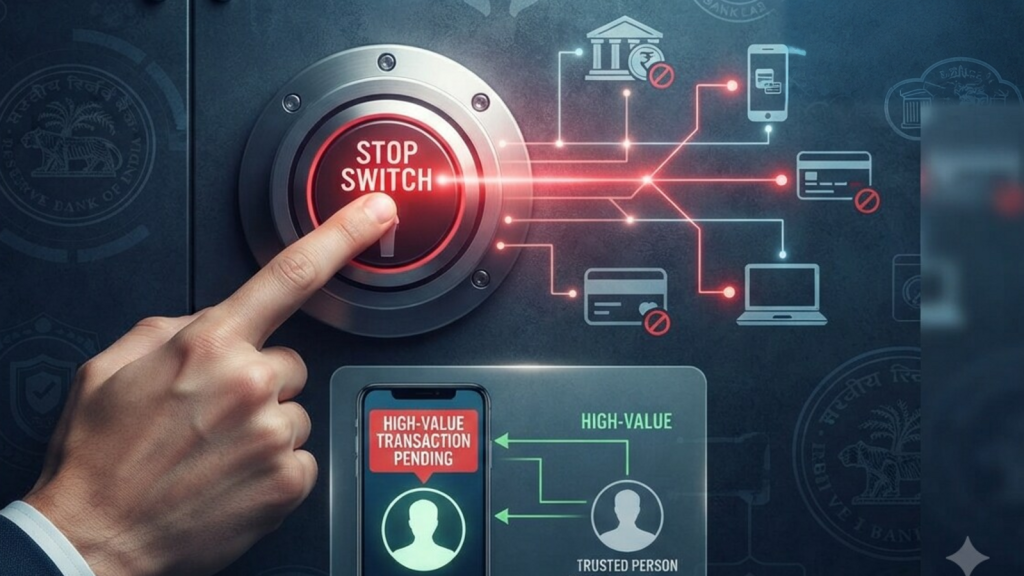
The Reserve Bank of India has proposed a set of customer-facing safeguards against digital payment fraud, including an emergency “Stop Switch” to halt outgoing debits, transaction limits that customers set themselves, and an option to nominate a trusted person who must approve high-value transfers. The measures form part of draft amendments to the central bank’s directions on responsible business conduct. RBI said the aim is to give customers greater control over digital payment facilities and to strengthen banks’ accountability in preventing electronic banking fraud. Comments from stakeholders and the public are invited until 14 December 2026. If finalised, the safeguards will take effect from 1 July 2027, or earlier if a bank chooses to implement them sooner.
Stop Switch blocks outgoing payments without freezing the account
The Stop Switch is designed as a single emergency control a customer can use when they suspect their account, banking credentials or digital payment access has been compromised, rather than approaching the bank separately to block each payment channel. Once activated, it will prevent the customer from initiating debit transactions, creating new payment mandates, setting up fresh standing instructions or registering UPI on new third-party payment applications.
It is not an account freeze. Incoming payments and credits will continue to be received, and existing recurring mandates and standing instructions will remain outside its scope. Bank-initiated debits, including loan instalments and bank charges, will also not be blocked. Customers will be able to deactivate the facility after completing a prescribed authentication process, and banks may impose reasonable cooling-off periods or additional safeguards before restoring payment facilities.
Customers can set limits channel by channel
The draft directions propose allowing customers to customise transaction limits across digital payment channels instead of relying entirely on ceilings prescribed by banks or payment system operators. A customer would be able to set a maximum limit for individual transactions, a daily limit for a specific beneficiary and an aggregate daily limit for a particular payment channel, as well as an overall daily limit covering all digital payment channels combined.
The proposals also include the option to specify time windows during which selected payment channels should remain disabled. RBI’s own examples: a customer could cap payments to a particular beneficiary at ₹20,000 a day even where the bank permits a higher amount, or set a maximum transaction limit of ₹10,000 on a particular payment channel.
These controls will extend to debit cards, credit cards and prepaid payment instrument cards. Customers will be able to switch domestic and international transactions on or off and set limits for ATM, point-of-sale, online and contactless payments. Banks will also have to keep digital payment channels disabled by default when onboarding new customers, with activation possible only after the customer gives explicit consent and completes the applicable authentication requirements.
Trusted Person Mechanism adds a second approval
The Trusted Person Mechanism will allow a customer to nominate an individual aged 18 or above to provide an additional layer of authentication for high-value transfers. The facility is voluntary and available to all customers. Nominations can be made through a bank’s physical or digital channels, and banks will verify the nominated person’s identity using an officially valid document.
The customer decides the transaction threshold above which the extra approval is required. When a transfer exceeds that threshold, the trusted person receives transaction details including the amount and beneficiary information, and has one hour to authenticate the transaction. If the trusted person rejects the transfer or does not respond within the stipulated period, the transaction will be declined. Both the customer and the nominated individual must give explicit consent, and banks will have to provide a 24-hour cooling-off period before activating the mechanism.
The nominated person will not gain access to the customer’s bank account, balance, fixed deposits, investments or insurance details. They cannot independently initiate transactions and will not be liable for transactions they approve or reject. The mechanism will not apply to UPI transfers, merchant payments or recurring payments through standing instructions, e-mandates and NACH mandates.
Wider definition of bank negligence from January 2027
Separately, RBI has proposed expanding the definition of bank negligence in cases involving fraudulent electronic banking transactions. The wider definition would cover failures to implement prescribed authentication requirements, to send mandatory transaction alerts, to provide round-the-clock fraud-reporting channels or to act promptly after receiving customer complaints. It would also cover certain system malfunctions, security breaches and instances of collusion involving bank employees or third parties engaged by banks. These expanded provisions are proposed to take effect from 1 January 2027.
Which banks are covered, and what happens next
The draft directions cover commercial banks, small finance banks, payments banks, regional rural banks, local area banks and cooperative banks through separate amendments. For customers, the proposals would mean more control over how money leaves their bank accounts, and clearer grounds for holding a bank to account when a fraudulent transaction slips through.
None of this applies yet. The safeguards will become available only after RBI finalises the rules and banks implement them, and stakeholders have until 14 December 2026 to send in comments on the draft. Until the framework is in force, customers who suspect fraud must continue to use existing routes, such as asking their bank to block a card, a payment channel or the account itself.