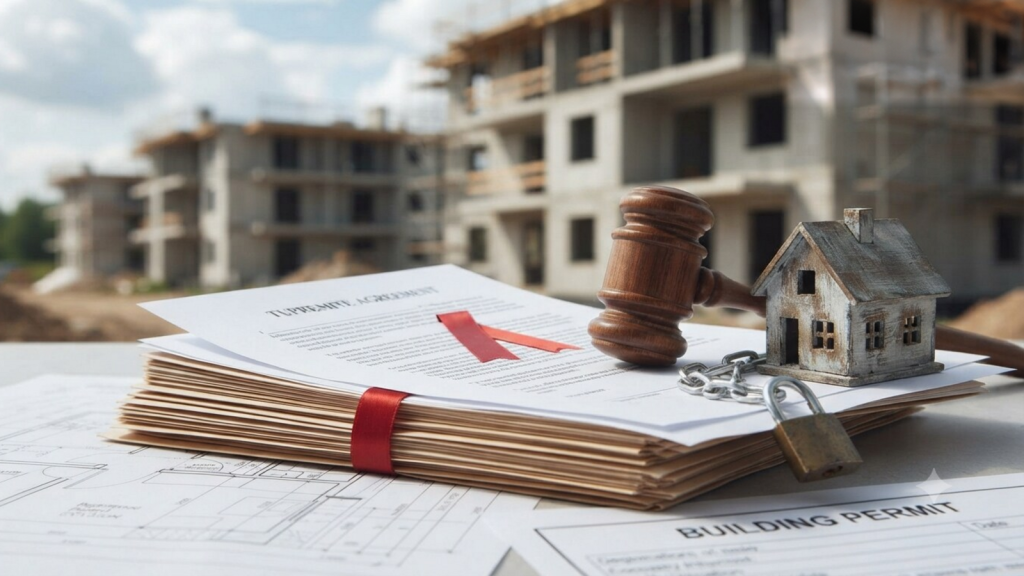
The Supreme Court has directed a Delhi commercial court to first decide whether State Bank of India (SBI) released home loan funds to Raheja Developers in line with a tripartite agreement before the court permits coercive recovery against buyers of unfinished flats in Gurugram. In an order dated November 19, 2026, a bench comprising Chief Justice of India Surya Kant and Justices Joymalya Bagchi and V. Mohana asked the Commercial Court at Saket to examine SBI’s disbursement conduct in Ravi Kumar Jangra and Another v. Union of India and Others, Writ Petition (Civil) No. 1415/2026.
The petitioners had bought flats in the Krishna Housing Scheme at Sector 14, Sohna, Gurugram, developed by Raheja Developers. They entered into a tripartite agreement with the developer and SBI to finance the purchases. Under that arrangement, the bank was required to release loan amounts in line with the progress of construction. The project remained incomplete, and the developer allegedly failed to honour its commitments under the agreement. The Supreme Court noted that although loan disbursements were linked to construction progress, the bank appeared to have released money to the developer without corresponding progress in construction.
Raheja Developers was admitted into the corporate insolvency resolution process (CIRP) by the National Company Law Tribunal (NCLT) on August 21, 2025. During the insolvency proceedings, the developer proposed to refund the amounts deposited by homebuyers in six monthly instalments. Meanwhile, SBI initiated recovery suits against the buyers before the Commercial Court at Saket, New Delhi. That court issued interim directions concerning payment of loan instalments.
The homebuyers approached the Supreme Court seeking protection against recovery proceedings. They argued that they had neither received possession of their flats nor the refunds proposed during the insolvency proceedings. The Supreme Court said it was the competent court’s responsibility to examine the relationship between the bank and the developer and determine whether loan disbursements followed the tripartite agreement. The bench said the competent court must first determine the nexus between the builder and the bank and examine whether the bank disbursed the loan amount to the builder strictly in terms of the tripartite agreement.
The Supreme Court further directed the civil court not to take coercive action against the petitioners or similarly placed homebuyers without first deciding whether the bank had complied with the agreement and whether the buyers were actually in default. It has also allowed the Commercial Court to modify its existing interim directions after hearing the parties. The order states that the court has not expressed an opinion on the merits of the case and has granted only interim protection against coercive recovery measures.
That distinction matters because a home loan is a contractual obligation between the borrower and the lender. An incomplete housing project does not, by itself, cancel the loan agreement or automatically extinguish the buyer’s repayment liability. The Supreme Court has not ruled that homebuyers are automatically exempt from repaying their housing loans whenever a developer delays or abandons a project. The key issue in such disputes is whether the bank followed the agreed disbursement schedule and whether the borrower is actually in default. If the bank released funds ahead of construction milestones despite being contractually required to follow a construction-linked schedule, the homebuyer can raise this issue in the recovery proceedings.
What homebuyers facing recovery can do
Check the tripartite agreement: Buyers should verify whether the bank was required to release loan instalments directly to the developer in proportion to construction progress. The agreement can help establish whether the lender followed the stipulated disbursement conditions.
Obtain the loan disbursement statement: Buyers should compare the amount released by the bank with the construction milestones achieved at the time of each disbursement. Relevant documents could include demand letters, construction progress certificates and communications from the developer.
Raise objections in recovery proceedings: If the bank has initiated recovery action, buyers should place their objections and supporting documents before the court or tribunal hearing the matter. They should not assume that the Supreme Court’s interim protection automatically applies to every stalled housing project.
File claims during insolvency: If the developer has entered insolvency proceedings, buyers should submit their claims to the resolution professional within the prescribed deadline, along with payment receipts, allotment letters, builder-buyer agreements and relevant bank documents.
The ruling offers a procedural safeguard to homebuyers who may otherwise face repayment demands despite not receiving their homes. However, the final determination of their repayment liability will depend on the agreements, the bank’s disbursement conduct and the findings of the competent court.