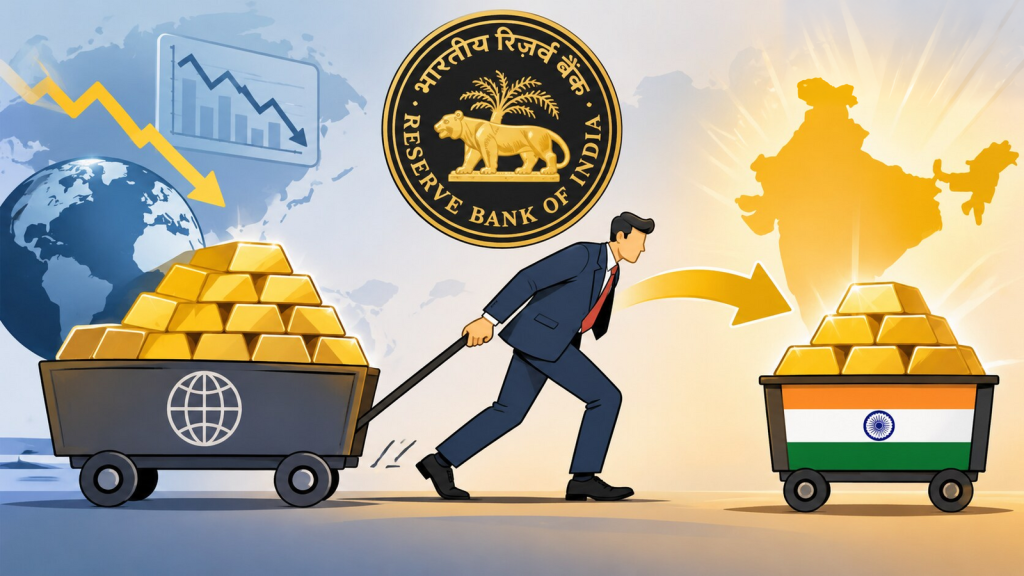
The Reserve Bank of India shifted 60.08 tonnes of gold from overseas vaults to domestic storage in the six months ended September 30, 2026, raising the share of its bullion held in India to 84.05% from about 77.2% at the end of March. The central bank’s total gold holdings were unchanged at 880.52 tonnes, so the operation changed where the metal is kept, not how much the RBI owns.
The figures are from the RBI’s Half-Yearly Report on Management of Foreign Exchange Reserves: April–September 2026, released on November 25. Gold is part of India’s foreign exchange reserves, and the RBI uses it to diversify reserve assets and provide a buffer against global economic uncertainty.
Where the RBI keeps its gold
At the end of September, 740.13 tonnes were held in domestic vaults in India and 140.39 tonnes were in safe custody with the Bank of England and the Bank for International Settlements. At the end of March, the split was 680.05 tonnes held domestically, 197.67 tonnes held overseas and 2.80 tonnes held as gold deposits. The deposit category did not appear separately at end-September.
The 60.08-tonne transfer increased the domestic share from approximately 77.2% to 84.05%. The total of 880.52 tonnes at end-September was identical to the end-March figure, indicating that the RBI did not add to or reduce its overall gold stock over the period.
Price fall and valuation
International gold prices fell from $4,721 per troy ounce in April to $4,319 in September, a decline of around 9%. Rising US Treasury yields, a stronger US dollar and expectations of tighter monetary policy weighed on prices. Continued investor demand for gold as a safe-haven asset and for portfolio diversification did not prevent the drop.
Gold prices remained under pressure after the half-year period. International spot prices stood at $3,590 per troy ounce, well below the September level cited in the report. Because the RBI’s holdings are valued at market prices, the decline reduced the dollar value of its gold reserves even though the quantity was steady.
Gold reserves were valued at $115.40 billion at the end of March and $106.08 billion at the end of September. Over the same period, India’s total foreign exchange reserves rose from $691.11 billion to $737.78 billion. As a result, the share of gold in total reserves fell from 16.70% to 14.38%.
That combination—flat tonnage, lower prices and higher overall reserves—explains the smaller gold share. The central bank held the same 880.52 tonnes, but the metal accounted for a smaller portion of the reserve portfolio in value terms.
What it means for consumers and investors
The move of gold from overseas vaults to domestic storage does not directly affect retail gold prices or change the cost of buying jewellery, coins or gold exchange-traded funds. It is a change in custody location within the RBI’s reserves, not a release of metal into the retail market or a signal that the central bank is selling gold.
For households and investors, gold prices will continue to depend on global market trends, currency movements, interest rates and geopolitical developments. The RBI’s holdings matter for the composition and valuation of India’s foreign exchange reserves, but they do not set the retail price of gold.
The report also shows how price movements can change the weight of an asset in reserves even when the underlying quantity is unchanged. The RBI ended September with more of its gold stored in India and the same total holding, while lower international prices reduced the metal’s value and its share of the reserve pile.