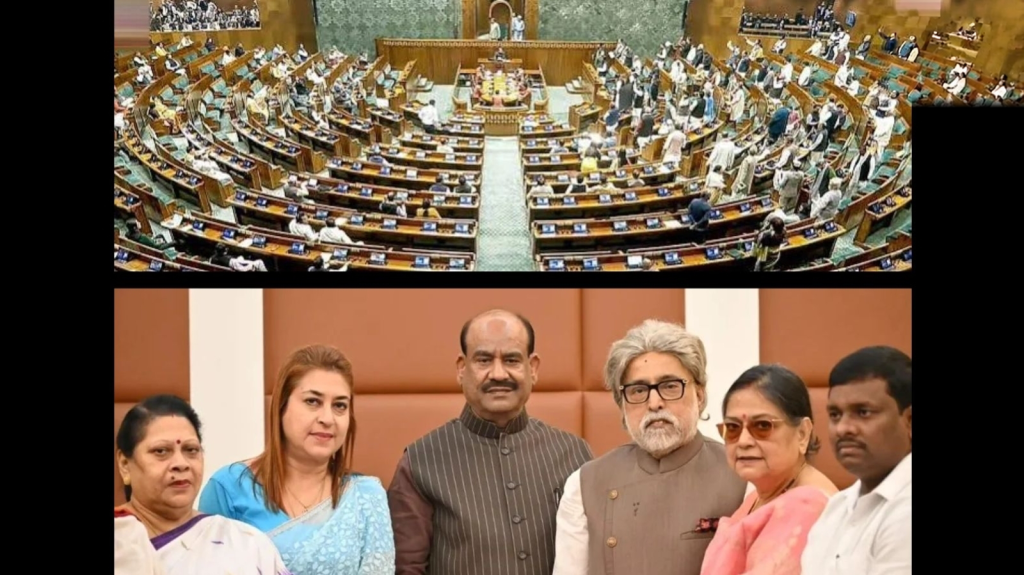
Twenty Trinamool Congress MPs facing disqualification proceedings can vote on the government’s Constitution amendment unless Lok Sabha Speaker Om Birla disqualifies them before the division. The Supreme Court’s settled position is that the mere pendency of a disqualification petition does not suspend an MP’s membership or voting rights. The government is preparing to return to Parliament next week to make another attempt to pass a Constitution amendment on the proposed delimitation exercise and women’s reservation, which requires a two-thirds majority, and the timing of Birla’s call has become central to the legislative arithmetic.
The 20 MPs broke away from the TMC in June and announced their merger with the Nationalist Citizens Party of India (NCPI), a little-known group that supports the ruling National Democratic Alliance (NDA). TMC Lok Sabha leader Abhishek Banerjee then approached the Speaker seeking their disqualification under the anti-defection law. Nearly six months later, the proceedings remain inconclusive. All 20 lawmakers submitted individual replies on November 24, defending their decision to leave the party.
TMC MP Sagarika Ghose has questioned the delay, alleging that the Speaker has not decided the petitions despite Supreme Court directions for an expeditious resolution. She also raised the question at the centre of the dispute: will these MPs be allowed to vote on the delimitation Bill while their disqualification petitions are pending, and would their votes remain valid if they are subsequently disqualified?
The immediate question
The constitutional position, as settled by the Supreme Court, is that a pending disqualification petition does not by itself suspend an MP’s membership or voting rights. Unless the Speaker passes an order disqualifying them before the vote, the 20 lawmakers remain entitled to participate in parliamentary proceedings. Even a subsequent disqualification would not automatically invalidate votes cast while the proceedings were pending.
The Supreme Court’s ruling in Subhash Desai also addressed the validity of proceedings conducted during the intervening period. It held that such validity cannot be made dependent on the eventual outcome of the disqualification case. Disqualification operates prospectively and does not relate back to the date on which the member allegedly incurred it. If the Speaker disqualifies the 20 MPs after the proposed constitutional amendment is put to vote, their participation in that vote would not become invalid retrospectively.
Where the Speaker’s authority lies
The Tenth Schedule of the Constitution vests the authority to decide disqualification petitions in the Speaker or Chairman of the House concerned. Under paragraph 6, the Speaker’s decision is final, subject to judicial review by constitutional courts. The Election Commission of India has no role in deciding whether the MPs have incurred disqualification under the anti-defection law. Its jurisdiction over disputes involving a party’s name and election symbol is a separate exercise.
The central question before Birla is whether the rebels can claim protection under paragraph 4 of the Tenth Schedule. That provision exempts legislators from disqualification when their original political party merges with another political party, provided at least two-thirds of the members of its legislature party agree to the merger.
Although 20 of the TMC’s 28 Lok Sabha MPs comfortably meet the numerical requirement, that alone does not establish a valid merger. In its May 2023 judgment in Subhash Desai Vs Principal Secretary, Governor of Maharashtra, a five-judge Constitution bench of the Supreme Court clarified that the merger contemplated under the Tenth Schedule must involve the original political party. It cannot be established merely by two-thirds of its legislators breaking away. The distinction between the original political party and its legislature party is therefore central to the Speaker’s adjudication.
The Speaker must examine whether the original TMC merged with the NCPI or whether the 20 legislators merely formed a separate group and sought to align themselves with another political formation. The rebels maintain that their action is constitutionally protected. The TMC argues that the anti-defection law does not permit a merger confined to the legislature party.
Why the timing of the decision matters
The Speaker’s authority, however, does not translate into an unrestricted discretion to keep disqualification proceedings pending indefinitely. In Kihoto Hollohan Vs Zachillhu (1992), the Supreme Court upheld the Speaker’s role as the adjudicating authority under the Tenth Schedule while making clear that the decision is amenable to judicial review. The court held that the Speaker functions as a tribunal while deciding such petitions.
More significantly, in Keisham Meghachandra Singh Vs Speaker, Manipur Legislative Assembly (2020), the Supreme Court held that disqualification petitions should ordinarily be decided within three months, barring exceptional circumstances. The ruling was intended to prevent delays from defeating the purpose of the anti-defection law by allowing legislators facing disqualification to continue enjoying the benefits of membership.
The Supreme Court, which last heard Banerjee’s plea seeking a time-bound decision in September, reiterated that the matter required expeditious adjudication. While declining to impose a specific deadline, the bench led by Chief Justice of India Surya Kant invoked the three-month principle laid down in Keisham Meghachandra Singh and emphasised the need for an early resolution. The submission of replies by all 20 MPs on November 24 removes one procedural hurdle, but it does not resolve the substantive dispute. The Speaker must now examine their defence and decide whether the merger claim satisfies the constitutional requirements.
The numbers behind the dispute
The stakes are heightened by the government’s earlier defeat on April 17, when its Constitution amendment secured 298 votes against the 352 required for a two-thirds majority among the 528 members present and voting.
The revised legislation seeks to increase the Lok Sabha’s strength from 550 to 850 seats, facilitating 33% reservation for women in Parliament and state assemblies before the 2029 general election. With the NDA currently having around 320 members, the government needs support from outside its alliance and favourable attendance to secure passage.
The status of the 20 TMC MPs could therefore influence the arithmetic. If they remain members, they retain their right to vote. If disqualified before the vote, the House’s effective membership and the applicable two-thirds threshold would change, but the government’s own voting strength would also fall.
With a crucial constitutional amendment awaiting Parliament’s consideration, Birla’s handling of the petitions could prove consequential not only for the future of the 20 MPs but also for the numbers surrounding one of the government’s most significant legislative initiatives.