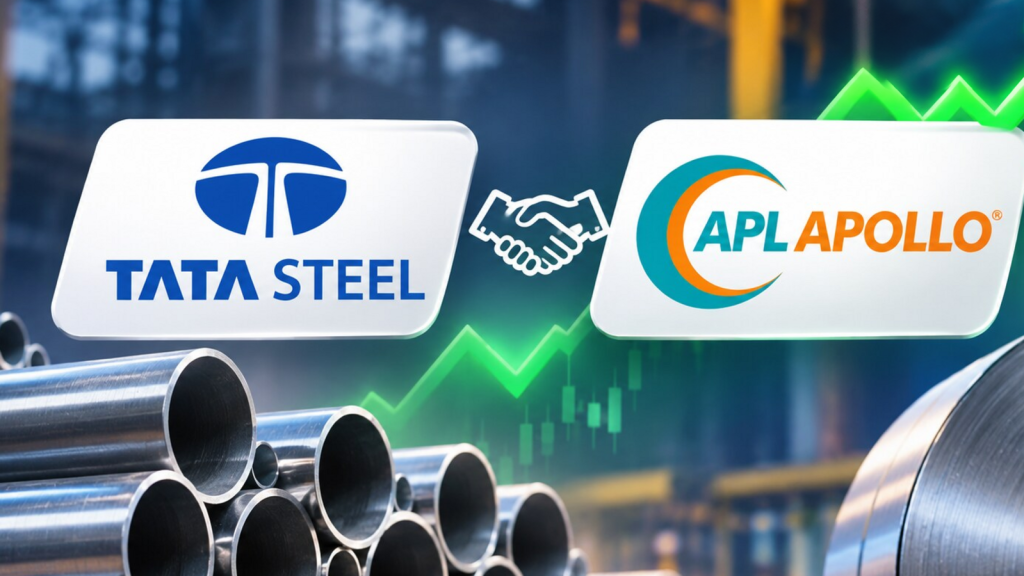
APL Apollo Tubes Ltd. is taking a ₹28,000-crore purchase of Tata Steel Ltd.’s tubes and colour-coated businesses to shareholders whose recent votes make approval uncertain. The steel-tube maker needs investor support for a debt-funded transaction that minority holders say leaves it carrying much of the borrowing behind Tata Steel’s larger takeover, and it is asking a shareholder base that has repeatedly rejected management-backed proposals.
Voting records show five of 11 special resolutions put to APL Apollo’s 2025 and 2026 annual general meetings failed. Such resolutions need at least 75% of votes cast in favour. In each defeat, public institutional investors provided most of the opposition while promoters backed the proposals. All five were tied to employee incentive plans. Rejections of employee stock plans are not unheard of in India, but failed resolutions remain uncommon and signal the challenge promoters face.
“Minority shareholders have strongly objected to the deal and questioned its structure, setting the stage for a tougher vote—should it happen,” said Amit Tandon, founder and managing director of Institutional Investor Advisory Services India Ltd. “For now, the situation remains one to watch closely.”
Deal structure and financing
The transaction has two legs. APL Apollo would buy two Tata Steel assets—its tubes and colour-coated businesses—for a combined ₹28,000 crore, funded through debt. Tata Steel would pay ₹15,510 crore for the 26.38% promoter stake in APL Apollo and make an open offer for another 26%, costing about ₹16,756 crore if fully subscribed. That puts Tata Steel’s total takeover outlay at ₹32,266 crore.
Minority investors argue the structure effectively makes APL Apollo shoulder most of the debt burden for Tata Steel’s takeover. APL Apollo borrows to buy the assets, while Tata Steel’s payments go to the promoter and, through the open offer, to public shareholders. Investors say the circular flow means APL Apollo is in effect helping finance Tata Steel’s acquisition of its own shares.
The promoter is set to exit at ₹2,100 per share, while other shareholders would be left holding a stock that traded at ₹1,668.15 on the BSE on Monday. The exit price is about 26% higher than Monday’s trading level, a gap that has added to minority investors’ complaints about the terms.
The concerns have triggered a sharp market reaction. APL Apollo has lost nearly a quarter of its market capitalization as investors continued to sell the stock since Monday.
Promoters, including Chairman and Managing Director Sanjay Gupta and other family members, own 28.3% of APL Apollo. Domestic public institutions hold about 20%, foreign institutional investors around 34%, and non-institutional public investors the remainder. Among the largest institutional shareholders as of September-end, foreign investors included New World Fund with 4.85%, Smallcap World Fund with 4.24% and Norway’s Government Pension Fund Global with 2.4%. Domestic mutual funds included ICICI Prudential Midcap Fund at 3.47%, Aditya Birla Sun Life Flexi Cap Fund at 2.02%, DSP Midcap Fund at 1.93% and Franklin India Midcap Fund at 1.77%.
A record of rejections
The resistance to management-backed proposals is not new. At its September 2025 annual general meeting, shareholders rejected four of six special resolutions, all relating to the proposed Employees Stock Option Plan, 2025. The resolutions covered introducing the scheme, extending it to employees of subsidiaries and associate companies, and authorising an employee welfare trust to buy shares in the secondary market using company funds.
APL Apollo had sought approval to issue up to 50 lakh stock options, leaving key decisions on pricing and employee eligibility to its nomination and remuneration committee. Support for the four resolutions ranged from 71.22% to 73.66%, short of the required threshold despite promoters voting entirely in favour. Opposition centred on pricing, disclosures and the benefits extended to employees of group companies. Legal & General Investment Management, which manages $1.5 trillion in assets, opposed all four.
The pushback extended beyond employee compensation. Several foreign institutional investors, including Norges Bank, LGIM and British Columbia Investment Management Corp., also opposed Sanjay Gupta’s reappointment as chairman. The resolution passed on 21 January 2025, but the objections pointed to wider governance concerns.
Norges Bank, which manages $2.2 trillion in assets, said the roles of chairperson and chief executive should not be held by the same individual. Where a company founder combines both roles, the fund said it may support that for a limited period provided the board has put measures in place to mitigate conflicts of interest.
The opposition continued at the September 2026 annual general meeting, when shareholders rejected a proposal to extend the company’s Stock Appreciation Rights Scheme, 2019, to employees of associate companies. The scheme allows eligible employees to benefit from an appreciation in APL Apollo’s share price. The resolution received 72.26% support, with 27.74% of votes cast against it. Four other special resolutions relating to the reappointment of independent directors were approved.
Why the deal vote matters
Investors and proxy advisory firms have opposed the Tata Steel transaction, calling its terms unfair to minority shareholders. The market backlash has prompted Tata Steel to consider restructuring the deal. Tata Steel Chief Executive T.V. Narendran said discussions were under way to address shareholder concerns on both sides.
The vote, if it proceeds, would test whether APL Apollo can win over investors who have already shown they will vote down proposals they consider disadvantageous. Promoters cannot carry a special resolution on their own 28.3% stake; they need support from public institutions and other shareholders to cross the 75% threshold. Foreign institutions at 34% and domestic institutions at 20% together hold about 54%, giving them decisive influence if they vote as a bloc. Non-institutional public investors hold the rest.
The failed employee-benefit resolutions show that domestic and foreign institutions are willing to join forces against management. LGIM’s opposition to all four 2025 ESOP resolutions signalled that a large global asset manager was prepared to vote against the board on remuneration issues. Norges Bank’s statement on combined chair and CEO roles highlighted governance concerns that go beyond the transaction.
For APL Apollo, the outcome is central to a transaction that would reshape its asset base and balance sheet. For Tata Steel, the deal is a route to exit a set of downstream businesses and gain control of a listed tubes maker. For minority shareholders, the question is whether the financing structure, the promoter’s exit price and the open-offer terms leave them with a fair share of the risks and rewards.
Whether the vote proceeds, and on what timetable, remains open. Until then, the focus remains on whether Tata Steel and APL Apollo revise the terms enough to win over the investors whose support they need.