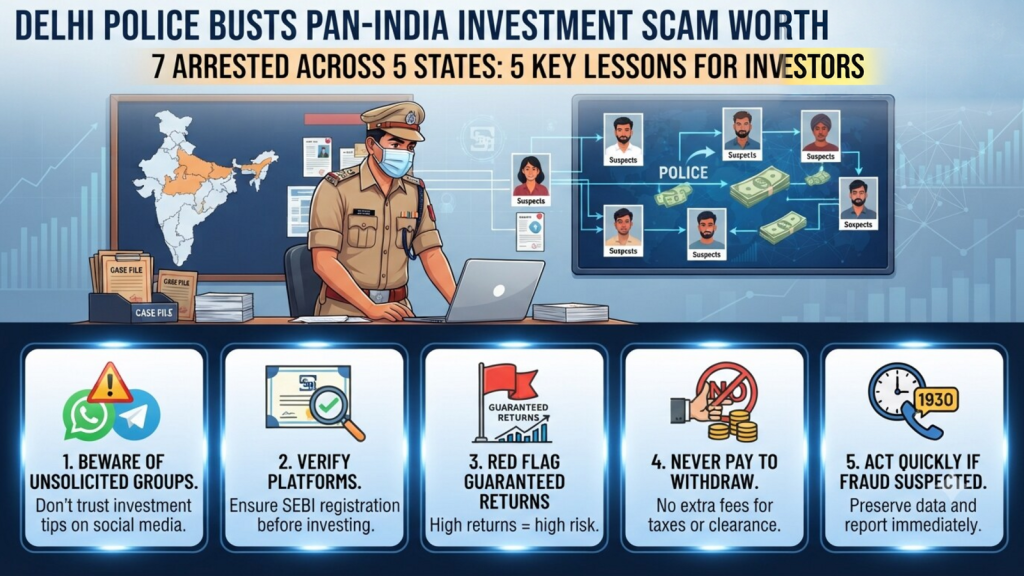
Delhi Police have arrested seven people across five states in connection with an alleged pan-India investment fraud that cheated a Dwarka-based family of ₹67.78 lakh. Police said the family was approached through two WhatsApp groups, “538 Action Price Lab” and “Victory Pioneers Capital,” by people who posed as stock-market professionals.
The accused allegedly shared fabricated screenshots, investment tips and promises of lucrative, easy returns to gain the family’s confidence. The family was then directed to a fraudulent website that displayed fictitious gains and fake initial public offering (IPO) allotments. Over 22 transactions, the family transferred ₹67.78 lakh into bank accounts provided by the accused.
Police said the accounts were linked to bogus firms and were used to divert the funds. The money was eventually withdrawn or converted into cryptocurrency, they added. Seven people have been arrested, and further investigation is continuing. The arrests cover five states, reflecting the geographic spread of the operation.
How the family discovered the fraud
The fraud came to light when the family tried to withdraw its money. The accused allegedly demanded an additional ₹1.10 crore, citing pending orders and other dues. The family refused to pay, after which the accused stopped responding. That is when the family realised it had been defrauded. The additional demand was far larger than the ₹67.78 lakh the family had already transferred.
The case illustrates how fraudsters combine the appeal of quick profits with the credibility that digital platforms can appear to lend. Group names, screenshots and a functioning website can create an impression of a real advisory or trading service, even when no genuine trades or IPO allotments exist. It also shows why investors need to verify both the people offering advice and the platforms receiving money before any transfer is made.
Five lessons for investors
1. Do not trust unsolicited investment groups. Any WhatsApp or Telegram group that promises expert stock-market tips or guaranteed profits should be treated as suspicious. Free investment advice should be checked through official Securities and Exchange Board of India (SEBI) sources rather than accepted at face value.
2. Verify the platform and intermediary. Before investing, confirm that the trading platform and intermediary are registered with SEBI. Investors should not transfer money to a third party or an individual’s account on the strength of a tip or screenshot.
3. Treat guaranteed returns as a red flag. Equity-market investments carry risk. Promises of unusually high or assured returns are a known tactic used by fraudsters to lure investors who are hoping for easy gains.
4. Never pay extra to withdraw money. A demand for additional payment — whether described as tax, pending orders or account clearance — can be a sign of fraud. Investors should never transfer more funds in an attempt to recover an existing investment.
5. Do not panic; preserve evidence and report quickly. If fraud is suspected, investors should keep transaction details, screenshots, messages and phone numbers. Cyber fraud should be reported immediately through the national helpline 1930 or the official cybercrime portal.
Verification before money moves
The investigation shows how carefully an investment fraud can be staged: a plausible group name, manufactured proof of gains, a website with fake IPO allotments and a network of accounts used to move funds. The family’s experience also shows that the demand for more money often comes at the withdrawal stage, when victims expect to receive their returns.
For investors, the practical response is to slow down before committing funds. Check the intermediary through official SEBI sources, understand the product, independently verify each transaction and keep records. A cautious approach may not eliminate every risk, but it can help prevent substantial losses and stop personal and financial data from being exposed to fraudsters. The family’s loss of ₹67.78 lakh came through 22 transfers, a reminder that fraud can build over multiple transactions rather than a single payment.