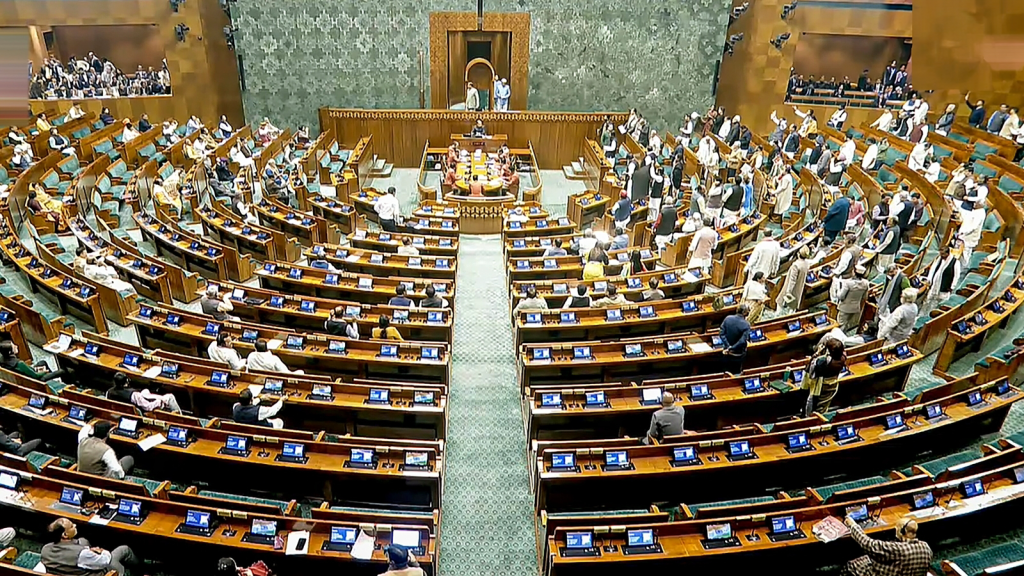
Delimitation returns to the centre of national politics when Parliament sits for four days from November 30, with the government having tied the redrawing of India’s electoral map to the implementation of women’s reservation in the Lok Sabha and state assemblies. The Union Cabinet was scheduled to take up the delimitation-linked women’s quota bill on Friday, although its text has not been made public. A Constitution amendment bill on the same subject failed in the Lok Sabha in April, by 298 votes to 230, and the government withdrew two companion bills soon after.
What delimitation does
Delimitation fixes two things: how many Lok Sabha seats each state gets, and where the boundaries of each constituency are drawn. Article 82 of the Constitution requires both to be readjusted after every Census.
India has carried out the exercise four times. The first, in 1952, fixed 494 Lok Sabha seats on the basis of the 1951 Census. The total rose to 522 in 1963 and to 543 in 1973.
Since 1976, each state’s share of Lok Sabha seats has been frozen at its 1971 Census level. An amendment that year held the shares until the first Census after 2000, and a later amendment pushed that date to the first Census after 2026. The stated rationale was to give states room to continue population-control programmes without fearing a loss of political weight.
Why the women’s quota depends on it
In 2023, Parliament passed the Nari Shakti Vandan Adhiniyam with near-unanimity, providing for about one in three seats in the Lok Sabha and state assemblies to be reserved for women.
The quota, however, does not take effect until a delimitation is carried out on the basis of the first Census conducted after the law came into force. Reservation operates constituency by constituency, so seats can be earmarked for women only once boundaries are settled. The reserved seats are also meant to rotate between constituencies after each delimitation.
That Census is still under way. Rather than wait for its results, the government’s April bills proposed using the most recent Census data available when a delimitation commission is constituted — in effect, the 2011 count. The government said this would allow the quota to be in place in time for the 2029 general election.
What the April bills contained
The government brought three bills to a special sitting on April 16.
The 131st Constitution Amendment Bill would have raised the ceiling on Lok Sabha seats from 550 to 850 — up to 815 from the states and 35 from Union territories. The Delimitation Bill would have set up a delimitation commission, headed by a sitting or retired Supreme Court judge, to readjust each state’s seats and redraw constituencies using the latest census.
The amendment required two-thirds of members present and voting; the other two bills needed a simple majority.
The fight was over how the additional seats would be divided. If all 850 seats were allotted by population on the 2011 Census, projections suggested the southern states’ share of the Lok Sabha could fall.
The seat-share row
Ministers sought to allay those fears. Law minister Arjun Ram Meghwal said every state would get 50% more seats. “The total Lok Sabha seats would be 815, and 272 will be reserved for women,” he told the House. Prime Minister Narendra Modi said there would be “no change in those ratios”, and home minister Amit Shah read out figures to argue that the share of the five southern states would rise.
The bills’ text, however, contained no explicit guarantee of a fixed proportion or a freeze on any state’s share.
The Opposition said it backed women’s reservation but not the delimitation bill, with leaders arguing that the assurances had been spoken in the House rather than written into law. The amendment drew 298 votes, 54 short of the 352 required that day. It was the first defeat of a government bill since the National Democratic Alliance came to power in 2014. The government withdrew the two linked bills soon afterwards.
What has changed since April
The arithmetic now looks different. The Lok Sabha has 540 members and three vacancies. The government needs 360 votes to pass the amendment, while the Opposition needs 181 to block it.
About 26 Opposition votes could disappear. Twenty of the 28 Trinamool Congress Lok Sabha MPs who broke away from the party say they will back the delimitation bill. Six of the nine Shiv Sena (UBT) MPs have joined the BJP-allied faction of the Shiv Sena. The Shiromani Akali Dal, which has one Lok Sabha MP, tied up with the BJP earlier this week ahead of the coming Punjab elections and is likely to support the government.
Two parties that opposed the bill in April have signalled a possible shift. The DMK, with 22 Lok Sabha MPs, has indicated it could support the bill if the government gives written assurances that Tamil Nadu’s seats will rise proportionally. “If the wording of the bill has changed, we will certainly be open to supporting it,” a senior DMK leader said on Thursday.
Sharad Pawar’s Nationalist Congress Party, which has eight Lok Sabha MPs, says its support depends on the bill’s provisions. Supriya Sule, the party’s working president and MP from Baramati, listed a 50% increase in Lok Sabha seats in every state and adequate representation for Opposition parties on the delimitation commission among its conditions.
If the Opposition loses another 30 or so votes, the government could be within striking distance of a two-thirds majority in the Lower House.
The Rajya Sabha hurdle and the assurances
In the Rajya Sabha the government needs 163 votes and has 154, so the Upper House remains a separate obstacle.
Government leaders said Shah has assured that no state would lose seats and that proportional representation would be maintained. The Congress has opposed the special sitting. Its leader Jairam Ramesh said on X that the government was “hoping that it will get its super-tainted two-thirds majority to pass a Constitution amendment bill”.
What to watch
Three things will decide the outcome. The first is whether the government writes the seat-share assurance into the bill text rather than repeating it on the floor of the House — the demand the DMK and the NCP have effectively made. The second is whether the census schedule allows a delimitation to be completed in time for the 2029 election, the deadline the government set for itself in April. The third is whether the numbers hold on the day: with 540 members in the Lok Sabha, attendance matters, as it did in April, when 528 members voted on the amendment.
Until the bill text is published, the central uncertainty remains unresolved — whether the protection against seat losses that ministers promised in the House will exist in law, or only in the record of a debate that ended in defeat eight months ago.