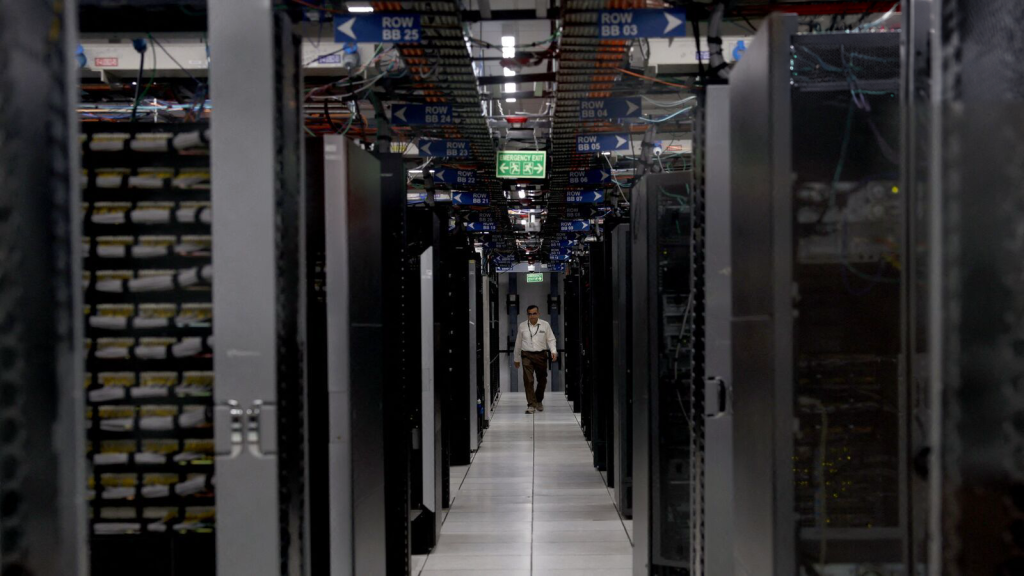
Diamond Power Infrastructure Ltd’s new data centre cable business generated ₹242 crore in revenue in its first month, equal to a quarter of the company’s July-September revenue, as the Gujarat-based cable and conductor maker moves to broaden its customer base beyond the Adani Group.
The company began supplying cables from a newly commissioned copper cable line in September, one month after raising ₹1,614 crore through a qualified institutional placement, or QIP, management said on a 4 November earnings call. The line has capacity of 1,500 tonnes a month, and Diamond Power plans to raise that to 2,500 tonnes, an increase of about two-thirds.
Amit Bhatnagar, head of corporate strategy, told analysts that the QIP funds came into the company in August. In September, the next month, it achieved record production of ₹575 crore. Of that, the team made and delivered ₹242 crore of data centre cables in a single month, he said.
The production figure underscores how quickly the new line was absorbed into the company’s operations. Diamond Power’s total output value in September reached ₹575 crore, and data centre cables accounted for ₹242 crore of that, or about 42%.
The cables were supplied to data centre engineering, procurement and construction contractors including L&T, AurionPro, Sterling and Wilson, and Blue Star, according to Bhatnagar.
Quarterly revenue more than doubles
The new business helped Diamond Power more than double its quarterly revenue year on year to ₹1,032 crore in July-September. The early contribution is significant for a company whose order book has been dominated by Adani group companies, and it comes as suppliers across India’s data centre chain seek to capture demand from cloud computing and artificial intelligence.
Around 3,860 megawatts of new data centre capacity is planned or under construction in India through 2030, according to a September report by real estate consultancy Cushman & Wakefield. That pipeline is drawing cable makers, electrical equipment suppliers and construction contractors into a market that did not exist at scale in India a few years ago.
Diamond Power does not expect the September revenue run rate to be sustained every month. It expects the data centre business to generate around ₹750 crore in fiscal year 2027, with the orders needed for that target already in hand, management said. The first month alone delivered almost one-third of that full-year target.
Supplying to data centres offers better margins than conventional cable contracts because customers have stricter requirements when selecting manufacturers, management said in response to an analyst’s question. “So obviously there is an entry barrier there. So this entry barrier leaves at least 2% extra margin for you,” management said.
Cutting the Adani share
The data centre push is also part of an effort to reduce reliance on Adani group companies. Rakesh Ramanlal Shah, Diamond Power’s promoter and a brother-in-law of billionaire Gautam Adani, acquired control of the company through a bankruptcy process in 2022 for ₹500 crore. Business with Adani has been central to Diamond Power’s growth since then.
The company maintains that all business from the conglomerate comes to it at market prices discovered through reverse auctions. Between FY24 and FY26, the Ahmedabad-based Adani group accounted for more than 80% of Diamond Power’s order inflow, according to an analysis of the company’s order trends. In FY27 so far, just over half of its orders, worth ₹2,474 crore, have come from Adani.
The promoter acquired control in 2022 through a bankruptcy process for ₹500 crore, and the Adani relationship helped the company rebuild its order book. The company now wants to replicate that scale with other customers.
Adani group companies accounted for 43% of Diamond Power’s outstanding order book of ₹3,735 crore as of 30 September. Their share of quarterly revenue was below 30%, Bhatnagar said, and the company aims to bring it down to around 20% over time.
Diamond Power now counts Tata Power, Waaree Energies, ACME Solar, CleanMax and Enrich among its customers and has set up dedicated teams to service them, Bhatnagar said on the investor call. “We served around 670 customers in the first half of 2027 across utilities, EPC players, data centres in the industry,” he said. “So we are on track to build our customer profile as we had promised you.”
The company has set up dedicated teams for these accounts, part of an effort to make its revenue less dependent on a single buyer group.
Exports and new orders
Exports will be another key part of the diversification strategy. Bhatnagar said the company has put together an export team and has already locked in a distributor in the UAE. “I can assure you, in financial year 2027-28, a large contribution shall come from exports,” he said.
The export effort is at an early stage, but the appointment of a UAE distributor gives the company a foothold in a nearby market.
The company’s order book has also been lifted by commodity prices. During the November call, management acknowledged that higher aluminium and copper prices had inflated revenue, estimating that price increases accounted for roughly one third of its year-on-year revenue growth.
The value of the company’s order book surged from ₹3,735 crore to ₹4,300 crore between 30 September and 4 November, driven purely by higher aluminium and copper prices, according to Bhatnagar. The company passes on price variations to its customers.
Analysts at InCred Research, in a note dated 4 November, warned that fluctuations in raw material prices and delays in ramping up production or executing orders could pose risks. The brokerage nevertheless remained optimistic about Diamond Power’s prospects, raising its target price to ₹470 from ₹440 on the back of strong orders, capacity expansion and a better product mix.
Diamond Power’s diversification effort therefore spans three fronts: data centre cables, a wider utility and renewable-energy customer base, and exports. The Adani group remains a large customer, but its share of revenue and orders is declining as the new businesses scale.
Investors have given a strong reception to the growth story. The company’s shares have risen nearly 163% since the start of 2026, more than doubling in value. Shah did not respond to emailed requests for comment.