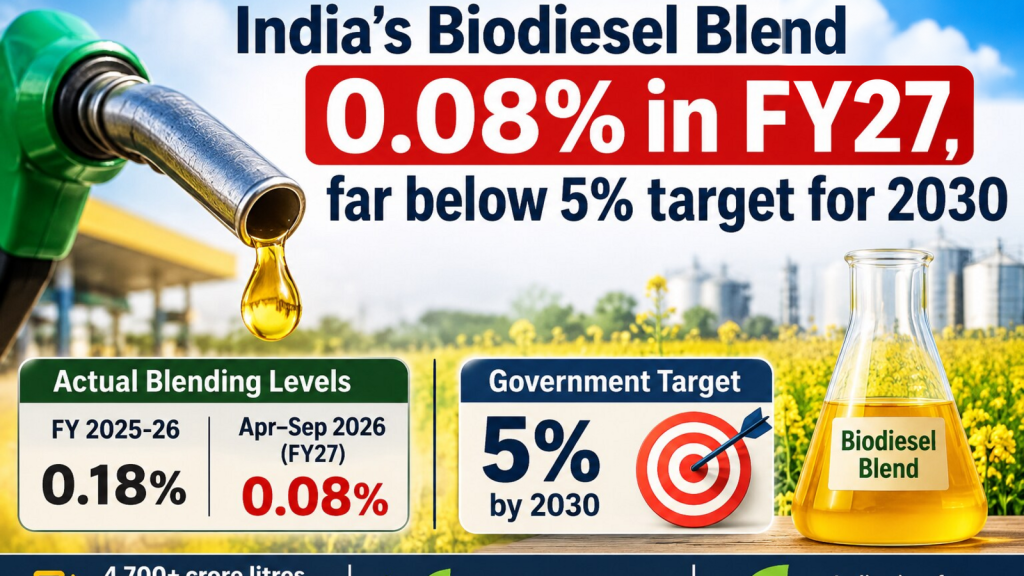
State-run oil marketing companies blended biodiesel at an average rate of just 0.08% during the first six months of the current financial year, a fraction of the government’s indicative target of 5% by 2030, Hindustan Petroleum Corporation Limited said in a clarification posted on social media platform X on November 19.
HPCL said Indian Oil Corporation (IOCL), Bharat Petroleum Corporation (BPCL) and HPCL — the three public sector oil marketing companies — together achieved an overall biodiesel blending level of just 0.18% during the financial year 2025-26, and that little has changed in the current year.
HPCL said the three PSU OMCs sold approximately 4,900 crore litres of high-speed diesel (HSD) between April and September 2026. More than 4,700 crore litres of that volume contained no biodiesel at all. Of the remaining roughly 200 crore litres, only 4 crore litres of biodiesel were blended into diesel, which works out to an average blending level of 2% within the fuel that carried any biodiesel.
Spread across all diesel sold in the country during the period, the overall industry blending level stood at just 0.08% in the first half of FY27. Any biodiesel used is therefore concentrated in a small slice of total diesel supply rather than spread across it.
HPCL attributed the shortfall primarily to limited availability of feedstock — the raw materials required to produce biodiesel. The 5% goal set out in the National Biofuel Policy, 2018, as amended in 2022, is described as an indicative target rather than a binding mandate, which means the blending programme is not currently tracking toward the 2030 milestone.
Diesel without biodiesel still meets IS 1460
Addressing concerns about the quality of diesel sold without biodiesel blending, HPCL said all high-speed diesel sales, including fuel containing very small quantities of biodiesel, comply with the Bureau of Indian Standards specification IS 1460. The standard sets the requirements for automotive diesel fuel and forms part of the publicly notified National Biofuel Policy framework.
HPCL said the PSU oil marketing companies remain committed to supplying fuel that meets prescribed quality standards and applicable regulatory requirements, and that buyers of unblended or lightly blended diesel are not receiving off-specification product.
Where India stands against other producers
HPCL pointed to biodiesel blending programmes in Indonesia, Malaysia and Brazil, where blending percentages range from 10% to 50%, depending on the availability of feedstock. India’s overall level of 0.08% in the first half of FY27 is far below the range the company cited for those countries, all of which have built out feedstock supply alongside their mandates.
The figures lay out the scale of the task facing state-run fuel retailers as India tries to expand the use of alternative fuels and cut its reliance on conventional fossil fuels. Without a larger feedstock base, raising the blending share from a sliver of total diesel sales to the policy’s 5% ambition remains distant.