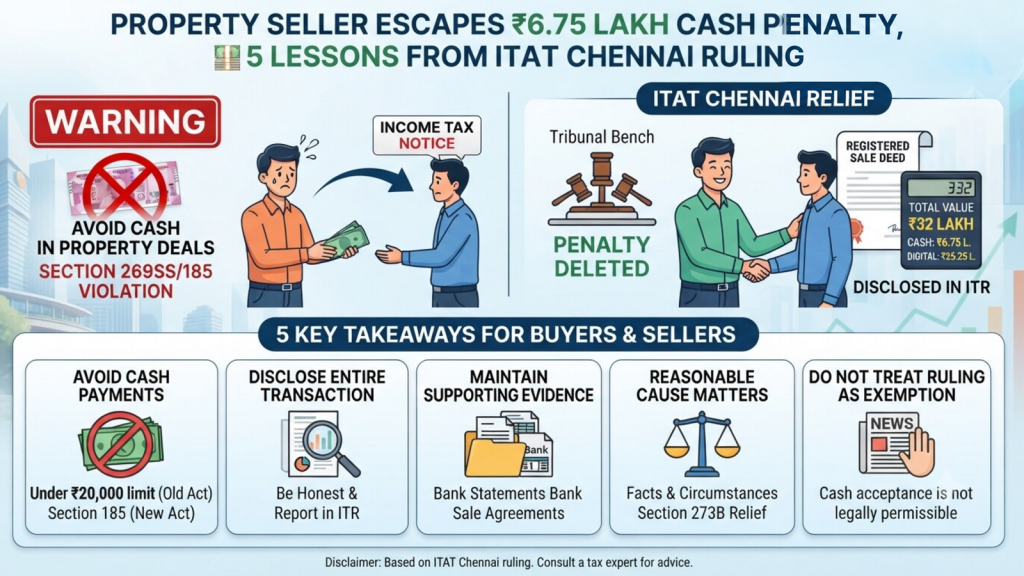
The Income Tax Appellate Tribunal (ITAT), Chennai, has deleted a ₹6.75 lakh penalty imposed on a property seller who accepted that amount in cash as an advance for a ₹32 lakh residential sale. In an order dated October 7, 2026, in Vetrichelvan Vijayasarathy v. ITO (ITA No. 1097/Chny/2026), the tribunal accepted that the seller had reasonable cause for the contravention and granted relief under Section 273B, even though it found a technical violation of Section 269SS of the Income-tax Act, 1961.
The case concerned a ₹32 lakh property sale. Vijayasarathy received ₹6.75 lakh in cash from a senior citizen buyer from Vellore and ₹25.25 lakh through banking channels. The full sale consideration, including the cash component, was recorded in the registered sale deed and disclosed in his income tax return. The Assessing Officer nonetheless treated the cash receipt as a violation of Section 269SS, which restricts cash receipts of ₹20,000 or more towards property advances, and imposed a penalty of ₹6.75 lakh under Section 271D.
The seller explained that the property was sold through a broker because he urgently needed funds. The buyer, a senior citizen, had travelled from Vellore to Chennai and paid the advance in cash to secure the deal. The seller said he did not want to wait two or three days for a bank transaction because that would have delayed the deal. He also said he was unaware of Section 269SS and believed that recording the entire transaction in the registered sale deed was sufficient compliance.
ITAT Chennai found no attempt to conceal or hide the transaction. It accepted that the seller had established reasonable cause under Section 273B and deleted the penalty. The tribunal did not hold that the transaction was exempt from Section 269SS. Instead, it held that the penalty under Section 271D could be waived because the taxpayer had shown reasonable cause for the contravention. The violation therefore remained; the seller was simply not penalized.
The ruling deals with a 2016 transaction and was decided under the Income-tax Act, 1961. From April 1, 2026, the Income-tax Act, 2025 applies. Section 185 replaces Section 269SS, while Section 450 prescribes the penalty and Section 470 provides relief where reasonable cause is established. Property transactions from April 1, 2026 onward are governed by the corresponding provisions of the 2025 Act.
The order draws a distinction between the legality of the cash receipt and the penalty for it. The tribunal did not say that the seller was permitted to accept ₹6.75 lakh in cash. It said the violation existed but the penalty could be waived because the seller showed reasonable cause. That distinction matters for buyers and sellers who assume that a genuine sale, a registered deed or full disclosure in an ITR will automatically neutralize a cash-receipt breach.
Five lessons for property buyers and sellers
1. Avoid cash payments
Section 269SS of the 1961 Act restricted cash receipts of ₹20,000 or more towards property advances, even when the initial deal did not materialize. The threshold is low compared with the size of most property transactions, and a cash advance can trigger a penalty under Section 271D; in this case, the penalty was equal to the amount received. The Chennai case arose because the cash advance far exceeded that limit. Buyers and sellers should route advances and sale consideration through banking channels, with a clear paper trail.
2. Disclose the entire transaction
The seller’s disclosure of the full ₹32 lakh in the registered sale deed and his income tax return helped establish that there was no concealment. The tribunal considered the taxpayer’s intention and integrity. Disclosure alone, however, does not make a cash transaction legally sound under income tax law, and it does not cure a Section 269SS violation.
3. Maintain supporting evidence
Keep bank statements, the sale agreement, transaction dates, payment records and related documents in order. Such evidence can help establish the fairness of a transaction if tax authorities raise questions. In this case, the record supported the seller’s explanation that the sale was genuine and fully disclosed.
4. Reasonable cause matters, but relief is not assured
Section 273B provides protection against certain penalties, including the penalty under Section 271D. Relief depends on the facts and circumstances of each case and is not automatic. The tribunal accepted the seller’s explanation in this case, but that does not mean every claim of urgency, ignorance of the law or reliance on a registered deed will succeed.
5. Do not treat the ruling as a general exemption
A fair property transaction or disclosure of a cash payment does not automatically make cash acceptance legally permissible or provide immunity from penalty. The ruling shows that Section 273B can provide relief in exceptional circumstances, but property buyers and sellers should prioritize traceable digital banking transactions to avoid legal scrutiny.
The ruling is specific to its facts. The information above is general and should not be treated as legal or tax advice.