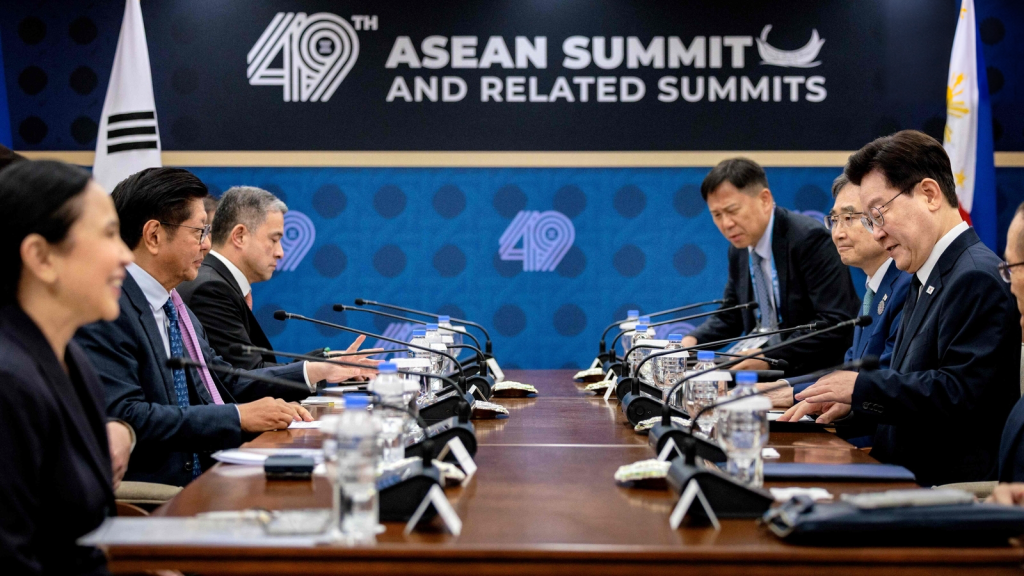
The Philippines is currently hosting the 49th Association of Southeast Asian Nations (ASEAN) Summit and its associated meetings in Manila. Running from November 15 to 17, 2026, the diplomatic event serves as a central hub for leaders from across Southeast Asia and key Indo-Pacific powers to deliberate on pressing matters of regional security, economic integration, and shifting geopolitical landscapes. Prime Minister Narendra Modi arrived in the Philippines on November 16 for a three-day visit, specifically to participate in the 23rd ASEAN-India Summit and the 21st East Asia Summit, according to the Ministry of External Affairs (MEA).
The Philippines, which holds the ASEAN chairmanship for 2026, has set the agenda under the theme “Navigating Our Future, Together.” Discussions at this year’s summits are expected to be comprehensive, covering critical issues such as maritime security, regional economic cooperation, the ongoing tensions in the South China Sea, and the persistent political crisis in Myanmar. While the ASEAN Summit primarily engages the 11 member nations of the grouping, the East Asia Summit provides an expansive, multi-stakeholder platform that includes India, China, the United States, and Russia. These forums have evolved over several decades, reflecting the region’s collective effort to address shared political, economic, and security vulnerabilities.
The Origins and Evolution of ASEAN
The Association of Southeast Asian Nations was founded on August 8, 1967, in Bangkok, Thailand, through the signing of the ASEAN Declaration, commonly referred to as the Bangkok Declaration. The five founding members were Indonesia, Malaysia, the Philippines, Singapore, and Thailand. According to the organization’s historical records, the grouping was established during the height of the Cold War to foster regional cooperation and fortify stability in Southeast Asia. At the time, the region was grappling with significant political instability and tensions between major global powers; the founding nations aimed to create a cooperative framework to prevent regional differences from escalating into conflict.
The Bangkok Declaration explicitly identified the promotion of economic growth, social progress, and cultural development through joint efforts as primary objectives. Furthermore, it advocated for regional peace and stability rooted in respect for justice, the rule of law, and adherence to the principles stipulated by the United Nations Charter. Over the ensuing decades, ASEAN matured into a sophisticated regional organization characterized by regular leadership summits, robust institutional mechanisms, and strategic partnerships with nations outside the Southeast Asian sphere.
The organization’s membership has steadily expanded. Brunei Darussalam joined in 1984, followed by Vietnam in 1995, Laos and Myanmar in 1997, and Cambodia in 1999. Most recently, Timor-Leste became the 11th member of ASEAN on October 26, 2025, marking the successful conclusion of a lengthy integration process. Following its expansion, ASEAN formalized the ASEAN Community in 2015, which operates under three distinct pillars: the ASEAN Political-Security Community, the ASEAN Economic Community, and the ASEAN Socio-Cultural Community. These pillars provide a structured approach to managing peace, economic integration, trade, investment, and developmental challenges.
The East Asia Summit and Wider Diplomacy
As ASEAN’s role in regional affairs grew, the necessity for a platform that could engage stakeholders beyond Southeast Asia became apparent. This resulted in the establishment of the East Asia Summit in 2005, with its inaugural meeting taking place in Kuala Lumpur, Malaysia, on December 14. Initially, the forum gathered the 10 ASEAN members along with Australia, China, India, Japan, New Zealand, and South Korea, forming a group of 16 participants.
The 2005 Kuala Lumpur Declaration defined the East Asia Summit as a leaders-led forum for dialogue on broad strategic, political, and economic issues of common interest. The forum significantly expanded its reach in November 2011 at the sixth summit in Bali, Indonesia, when the United States and Russia were formally admitted. With the addition of Timor-Leste to ASEAN in 2025, the East Asia Summit now comprises 19 participating nations. The forum serves as a venue for addressing complex issues, including maritime security, energy security, climate change, public health, and connectivity, with the ASEAN chair presiding over proceedings.
Distinct from these are other regional mechanisms, such as the ASEAN Plus Three, which includes the 11 ASEAN nations alongside China, Japan, and South Korea. Established in 1997 as a response to the Asian financial crisis, this group has since broadened its scope to encompass finance, trade, food security, and regional economic integration. Together with bilateral summit meetings with partners like India and the US, these platforms form a complex, layered diplomatic framework for the region.
India’s Strategic Engagement
India’s engagement with Southeast Asia is long-standing, predating the birth of the East Asia Summit. The relationship commenced with a sectoral dialogue partnership in 1992, which was subsequently elevated to a full dialogue partnership in 1996 and reached the summit level in 2002. As one of the 16 founding participants of the East Asia Summit in 2005, India demonstrated its commitment to fostering closer economic, political, and strategic ties with Southeast Asian nations and the broader Indo-Pacific.
This engagement was significantly energized by the launch of the Act East policy in 2014. As noted by the MEA, this policy prioritizes the enhancement of connectivity, commerce, and cultural exchanges with ASEAN members. The current cooperation covers a wide range of domains, including trade, infrastructure development, maritime security, and defence. For India, these summits serve as vital opportunities to engage with other major regional powers on issues that directly impact the stability and prosperity of the Indo-Pacific region.
Persistent Challenges and Regional Outlook
Despite the institutional growth of ASEAN and the creation of inclusive platforms like the East Asia Summit, participating countries continue to face substantial hurdles. Maritime disputes in the South China Sea remain a primary concern, characterized by ongoing disagreements involving China and several ASEAN member states. While negotiations regarding a proposed Code of Conduct have been underway for years, reaching a definitive consensus has proven difficult. Furthermore, the political crisis in Myanmar continues to present a testing environment for the grouping. The ASEAN Five-Point Consensus, adopted in 2021 to mitigate the crisis, has faced significant implementation challenges, highlighting the limits of the organization’s collective action in the face of deep-seated domestic political strife. As leaders gather in Manila, they must also navigate the broader challenges of intensifying strategic competition between the US and China, alongside growing concerns over supply chain reliability and global economic uncertainty.