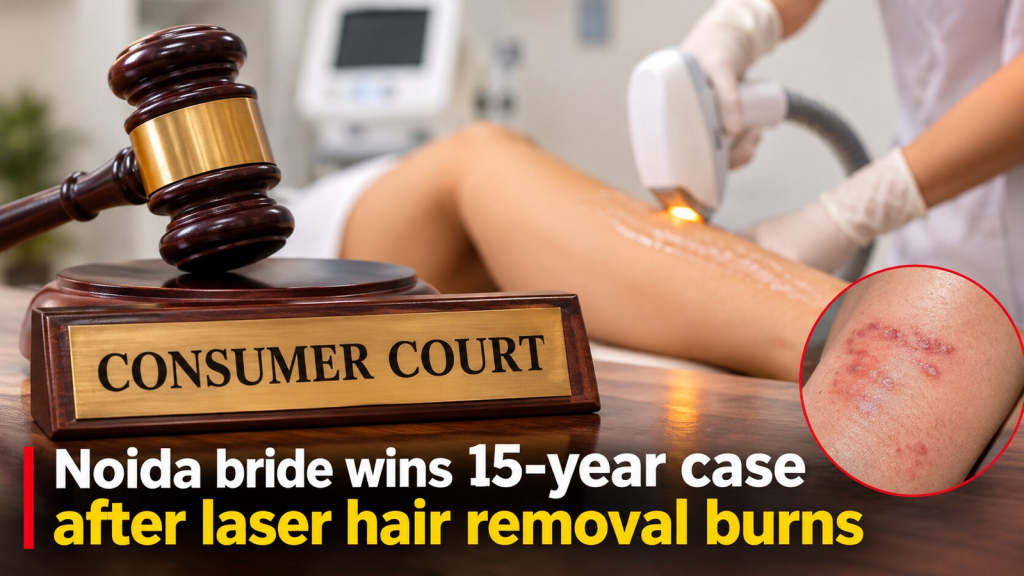
A consumer commission in Noida has ordered Berkowits Hair and Skin Clinic in Sector 18, Noida, to pay ₹1.54 lakh, plus interest, to a Noida woman who suffered burns and blisters during a laser hair removal session in 2011, ending a 15-year dispute.
The District Consumer Disputes Redressal Commission held the clinic guilty of deficiency in service. The order was passed on November 4 by commission president Anil Kumar Pundir and member Anju Sharma. The clinic must comply within 30 days.
What the commission ordered
The commission directed the clinic to refund ₹99,000 that the woman had paid for the treatment, with 6% annual interest. It also ordered ₹50,000 as compensation and ₹5,000 toward litigation expenses. Those amounts add up to ₹1.54 lakh, apart from the interest on the refund.
The complaint was filed on December 12, 2013, by the woman through her mother, Santosh Redu. The dispute dates to the period before her wedding, which was scheduled for September 9, 2011. She approached the clinic after seeing advertisements for permanent hair removal and wanted the procedure completed before the wedding.
Treatment and injuries
According to the complaint, the clinic assured her that the treatment would be completed in four to six months through six or seven sessions. She was told that doctors and experienced laser technicians would supervise the procedure. The total cost was ₹99,000, which she paid in three installments.
She underwent her first session on February 2, 2011. During the third session on May 22, she experienced severe burning, pain and itching on her back and legs. Burn marks and blisters later appeared. When she informed the clinic, its staff advised her to apply skin creams, according to the complaint.
A dermatologist examined her on May 25 and prescribed medication for seven days. The woman told the commission that the injuries affected her wedding preparations and forced her to postpone the marriage. She also said she had to spend additional money on medical treatment.
She later approached the chief medical officer in Noida. According to her complaint, a medical examination found that the injuries had been caused by excessive exposure to laser rays. She alleged that the clinic refused to refund her money despite repeated calls and emails.
Clinic’s defense
The clinic denied negligence. It argued that there was no expert medical opinion establishing that it had made a mistake during the procedure. It said the woman had been informed about possible side effects, including skin irritation, itching and burns, before the treatment began and had signed an informed-consent form.
The clinic claimed that the technician repeatedly checked whether the laser intensity was bearable. It said the woman wanted higher intensity for better results and told the technician that she could tolerate it. The clinic also said she had been advised to use an ointment called Fusibet and apply ice to affected areas in case of irritation or burns, and alleged that she did not follow those instructions.
The clinic cited its 25 years of experience and said it had treated more than three lakh customers. The commission did not accept its arguments.
Supervision and consent
After examining the documents and submissions from both sides, the commission found that the clinic had failed to establish that a qualified dermatologist was physically present and supervising the third laser session. It rejected the clinic’s claim that the woman had agreed to the laser intensity, saying the argument was not supported by sufficient evidence and did not remove the clinic’s responsibility to monitor the procedure.
The panel observed that the technician continued the treatment even after the woman complained of burning sensations. The doctor examined her only after burn marks and blisters had appeared. The commission said this fell below the standard of care expected from a clinic offering laser treatment and amounted to deficiency in service.
The commission also addressed the informed-consent form. It said that agreeing to the possible risks of a medical or cosmetic procedure does not mean a patient accepts injuries caused by negligence. A patient may consent to known risks, but that does not excuse a clinic from failing to monitor treatment, exposing the skin to excessive laser intensity or continuing a procedure despite complaints of burning.
The ruling ends the woman’s consumer dispute over the 2011 treatment. The clinic has 30 days from the order to make the payments and comply with the commission’s directions.